
Across thirteen distilleries, Denmark’s whisky story runs through local barley, unusual smoke, unfinished ambitions and the people determined to see them through.
WORDS: Mark Jennings
PHOTOGRAPHS: Ulf Lundquist
The steam locomotive is the first indication that I have misjudged the scale of things.
It is inside the warehouse at Nyborg Destilleri, surrounded by casks. An actual locomotive, occupying a substantial amount of a building that can, apparently, spare the space. The old railway works have the height and breadth of somewhere built for heavy objects and serious work. The copper stills look quite comfortable here.
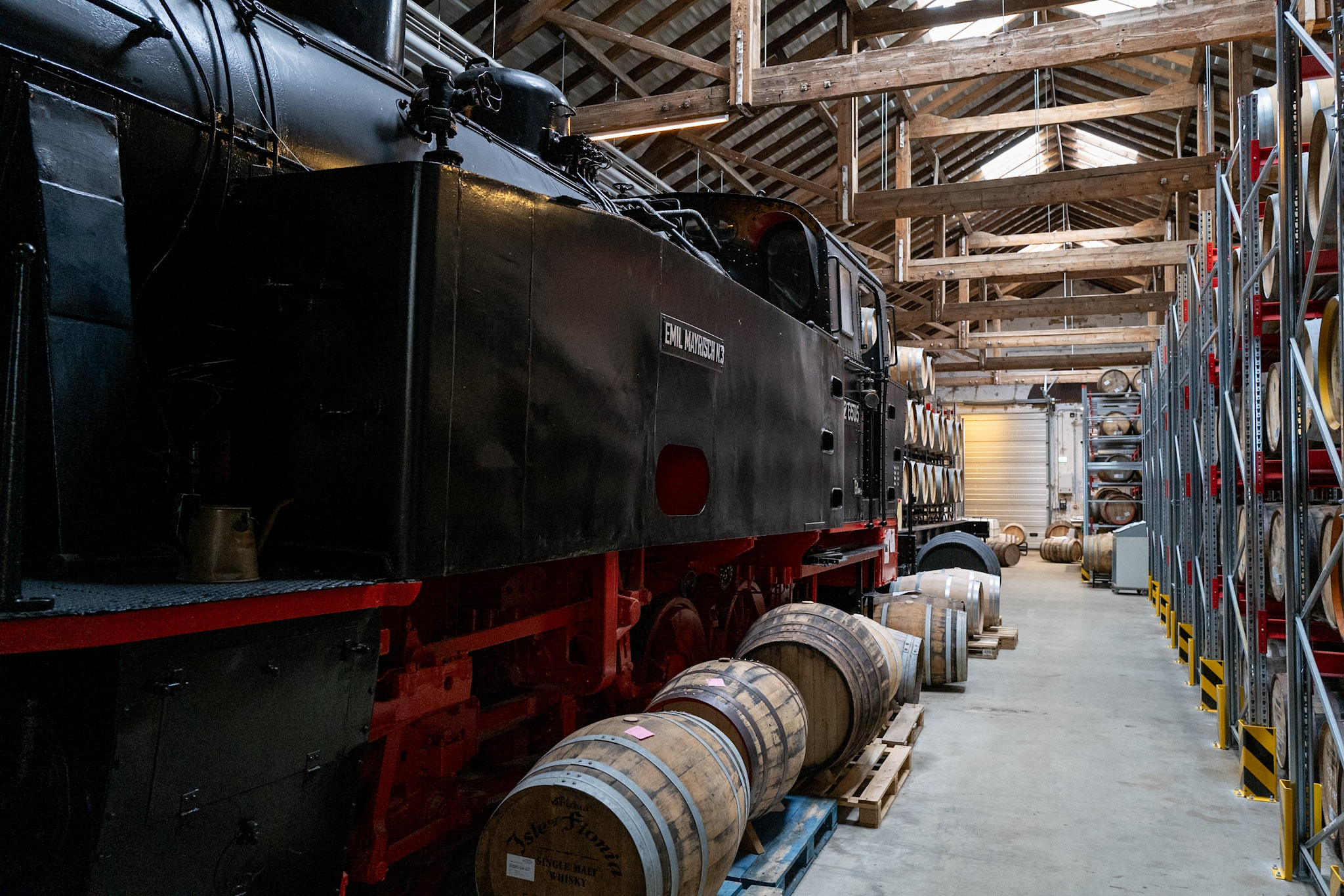
It is Sunday, 28 June 2026. Nicolai Rømer, the distillery’s co-founder, has come in to welcome us. He lets us eat before taking us round. There is beer, then whisky, then rather more to see than I had anticipated. Somewhere in the process, the evening ceases to be an arrival and becomes a visit.
We have also been to the family brewery, Ørbæk, where Nicolai has shown us tiles he laid and rooms he helped build. He remembers carrying the malt himself. The brewery now has people to do these things. At the distillery, there are still plenty of things for Nicolai to do.
He likes machinery. More particularly, he likes machinery working: bottles moving, casks being filled, a process coming together and beginning to run. He can look at a tangle of practical problems and see a way through it. That confidence has already helped build one business.
Put a glass of his whisky in front of us, however, and the confidence becomes something more watchful.
Nicolai wants to know what we think. Showing somebody what you have made involves a moment when you have to stop explaining and let them decide.
Some of the whisky I like very much. A Danish-oak expression has sweetness, an arresting cool, almost menthol quality, and a green citrus note that becomes more vivid when Nicolai produces a stronger version. One of the heavily cask-led whiskies is much less convincing to me. The sweetness takes over. These are different outcomes from a distillery still working out what it does best, and Nicolai is willing to let us encounter both.
By the time Ulf and I sit outside to make sense of the evening, Sunday has become Monday.
Ulf Lundquist is well over six feet tall, with an angular face that can look stern until it breaks into a smile. He listens for a long time, then adds something that makes you reconsider what you have just said. He has brought cameras and cigars. When he tells me how good the cigars are, I am willing to take his word for it.
For the next several days we will share a camper van, visit distilleries, taste whisky and record conversations about what we have seen. The van will variously be too hot, too cold and insufficiently enthusiastic about letting air in. We will learn quite a lot about whisky, and a little about how close two people can live without having an argument.
The project is to visit all thirteen distilleries signed up to the Danish Whisky Manifesto. We have already been to Thornæs and Copenhagen Distillery, before beginning the main road journey. The manifesto has covered our trip costs; I have not been paid to write this. The distinction matters, although it does not make hospitality powerless. I like being welcomed. Most people do.
The question I have brought is straightforward enough to sound foolish. What is Danish whisky?
At Nyborg, the difficulty is already apparent. There is organic grain, a family business, Scottish connections, a former railway building, enormous stills and an owner who talks openly about what he is still learning. There is whisky I would happily drink again, alongside work I think needs reconsidering.
There is also the question of how much more whisky to make.
Nicolai likes to buy equipment with room to grow. He has seen the wisdom of that at the brewery. But a warehouse full of spirit is money committed to a future customer who may take years to arrive. In our interview the following morning, his questions come out almost as a conversation with himself: how many casks, how long to keep them, what the future will require.
“How much can we sell?”
That is a less romantic place to begin than a locomotive. It will prove considerably harder to leave behind.
The copywriter and the chemist
Our first visit, on 24 June, began at Thornæs, with Torben Thornæs Andersen looking a little past me into the distance.
He is ruddy-faced and earnest, more comfortable once there is something to show us than when I begin by asking him to define himself. This is understandable. Torben spent years as a copywriter and journalist. He knows what can happen when somebody else chooses your words.
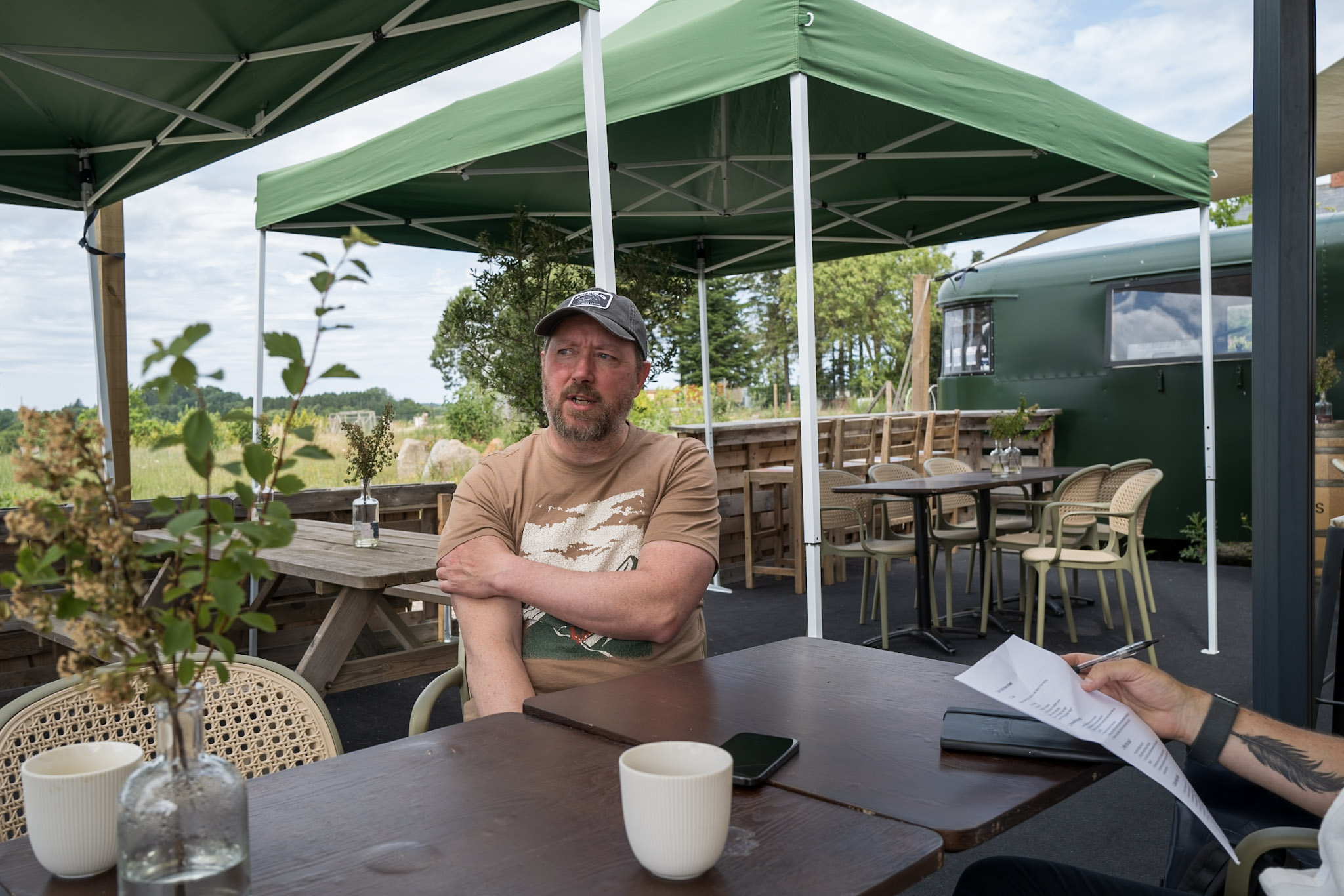
His distillery is on a farm in North Zealand, with fields outside and a landscape he describes with much greater ease than he describes a national whisky identity. There is a dead tree by the water where sea eagles gather. He tells us about it at length. When he went looking for somewhere to establish a distillery, this was the part of Denmark he wanted to work in.
Before the whisky, there was a master’s degree in Danish literature, advertising, independent work and travel writing. The travels put him in front of wineries, breweries and distilleries. Somewhere in his forties, he began to wonder what the most magnificent reinvention of his working life might be.
It was not necessarily the most rational one.
I know something about the appeal of leaving advertising. I am less certain that I would have responded by buying distilling equipment. My instinct would be to research the subject until either the opportunity or I had died of old age. Torben decided, sought training and help in Scotland, found a farm building, brought people into the project and began.
There were enough people telling him it was a bad idea to make proving them wrong a useful source of energy.
He named the distillery after himself, or rather after his middle name, which had itself been assembled from family geography. Among other advantages, customers would know whom to complain to.
Inside, the equipment is practical, clean and unshowy. Cable ties help hold the working arrangement together. This is something a man has built in a rented building because he wanted it to exist.
The whisky has already travelled beyond the most obvious Scottish reference points. Chestnut is particularly persuasive. One expression, four and a half years old, has fruit, length and a lovely balance between the wood and the grain. There is plenty happening without the drying astringency I might have feared. Ulf, whose previous experience of Danish whisky has been limited, is reconsidering his expectations.
Torben also talks about Bulgarian oak and birch smoke. Birch connects to childhood and to the Nordic world he knows; trees have been cut locally and chipped for smoking malt.
These are not yet a settled set of answers. He is trying things, finding what works and beginning the harder task of deciding what deserves to remain.
“I think we’re still in that phase where we’re building an identity,” he says.
When I ask what Denmark can offer that older whisky countries cannot, his answer eventually turns away from equipment. The difference might be “an attitude” or “a behaviour”.
I am interested, although also wary. Attitude is a marvellous thing to sell because it is difficult to measure. Here, at least, there is whisky to put beside the proposition. Chestnut has to earn its place in the glass. The countryside cannot do that for it.
The next day, Copenhagen Distillery offers a rather different kind of reassurance.
Lasse Öznek has dark, mid-length hair, a greying beard and moustache, and an intensity that makes a question feel like the beginning of a much longer conversation. He looks directly at you to check that a point has landed, then looks away as he finds the next way to explain it. There is a quick, almost youthful smile beneath the precision.
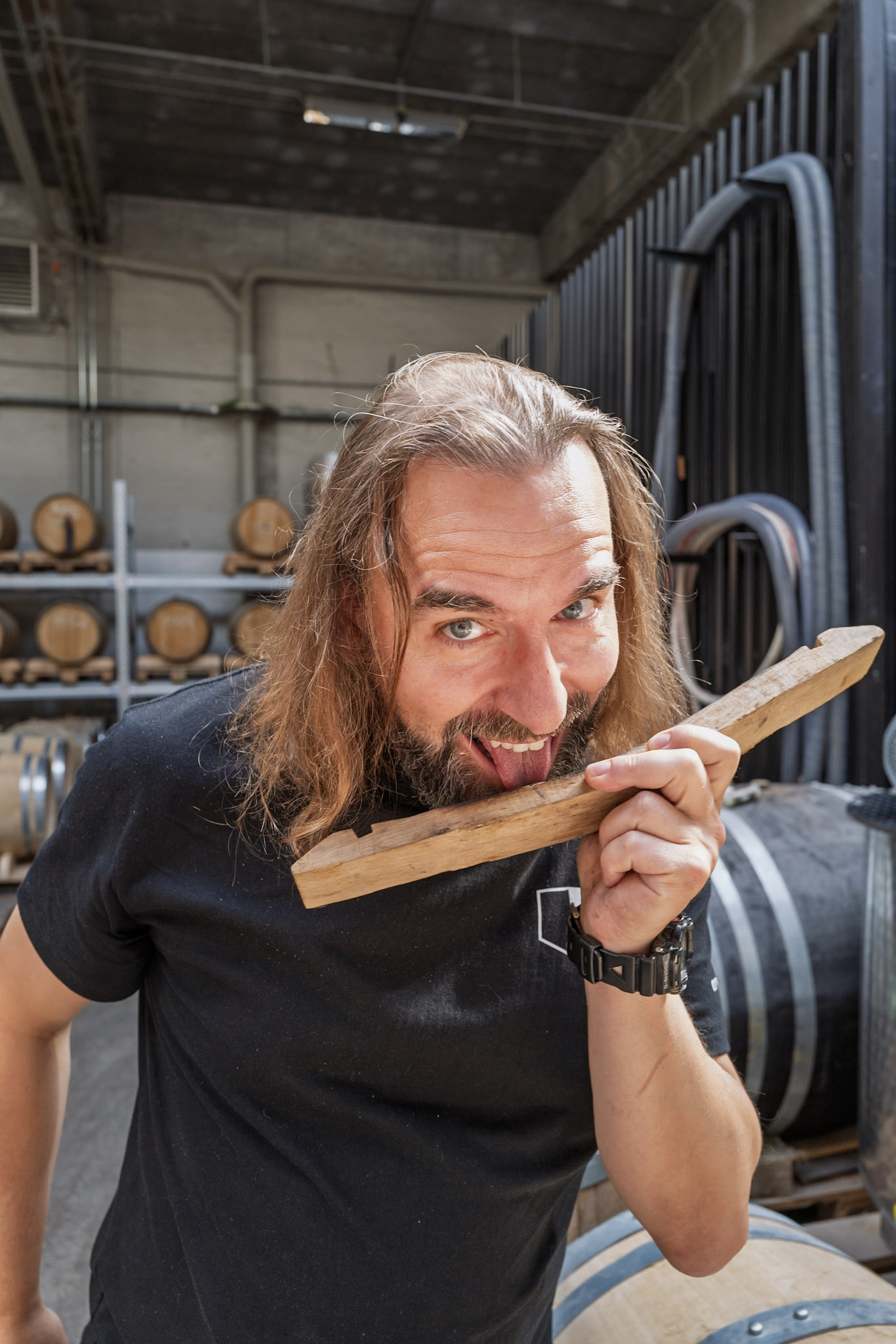
Read some of his statements cold and you might find him overbearing. Sit with him and the eagerness becomes harder to resist. He wants you to understand why he has done something. Preferably at molecular level.
We are in a former industrial building in the city. A long bar and a generous communal space sit beside the production area, visible through glass. This is somewhere to gather, listen, talk and drink together. The fields are elsewhere. The sign declares the ambition plainly: distinctively Danish.
Lasse, a chemist, is quite clear about what that means to him.
“For me to be Danish is definitely not being a copy, it is being innovative.”
His hybrid still is useful because it gives him control over what he collects and what he leaves behind. He talks about distillation as separation, about the limitations of a conventional pot still, about retaining the grain solids through fermentation and distillation. The bacteria associated with the barley are part of his intended flavour development. The methods have been chosen for a particular result.
There is nothing casual about his experimentation. Some parts of the process are fixed precisely because he has spent so long finding where he wants them. Other parts remain a playground. A spirit we taste can turn out to have been made chiefly to season a cask for something else. The apparently finished thing is an ingredient in the next thing.
I find one of the whiskies strikingly reminiscent of snaps, although it has not simply been put in a snaps cask. That is more interesting to me than being told it is innovative. I have encountered a flavour I did not expect, and the explanation changes my understanding of what I have tasted.
Lasse sees Copenhagen’s cocktail culture and urban life in his work. A Negroni cask makes sense to somebody who has a bar, likes Negronis and spends his days thinking about how flavours can be assembled. It would be too easy to dismiss that as city branding. A person’s surroundings can supply ideas as well as raw materials.
But his certainty is not the certainty of a man who thinks the work is finished.
“I think the day I think that I know everything, I will quit.”
Torben and Lasse could have supplied an easy opposition: rural storyteller and urban scientist. Both make that division inconvenient. Torben has learned a technical craft. Lasse is a remarkably accomplished communicator. Both are using whisky to make something personal and then asking other people to care about it.
The manifesto they have signed is a short, voluntary agreement. It requires mashing, fermentation and distillation in Denmark, and at least three years’ maturation there. It places conditions on grain origin and transparency, forbids added colour, flavouring and sweeteners, and leaves room for different cereals, stills and maturation woods.
The interesting choice is where it draws the line. It is fairly specific about where the work happens, and deliberately permissive about how.
The room he never reached
On Monday we take a ferry to Ærø.
This is the exception to the pattern of the trip. There has been no arranged interview with the principal whisky maker. A local guide shows us the compact distillery and pours several whiskies. The village, the small scale of the equipment and the island setting are all immediately appealing.
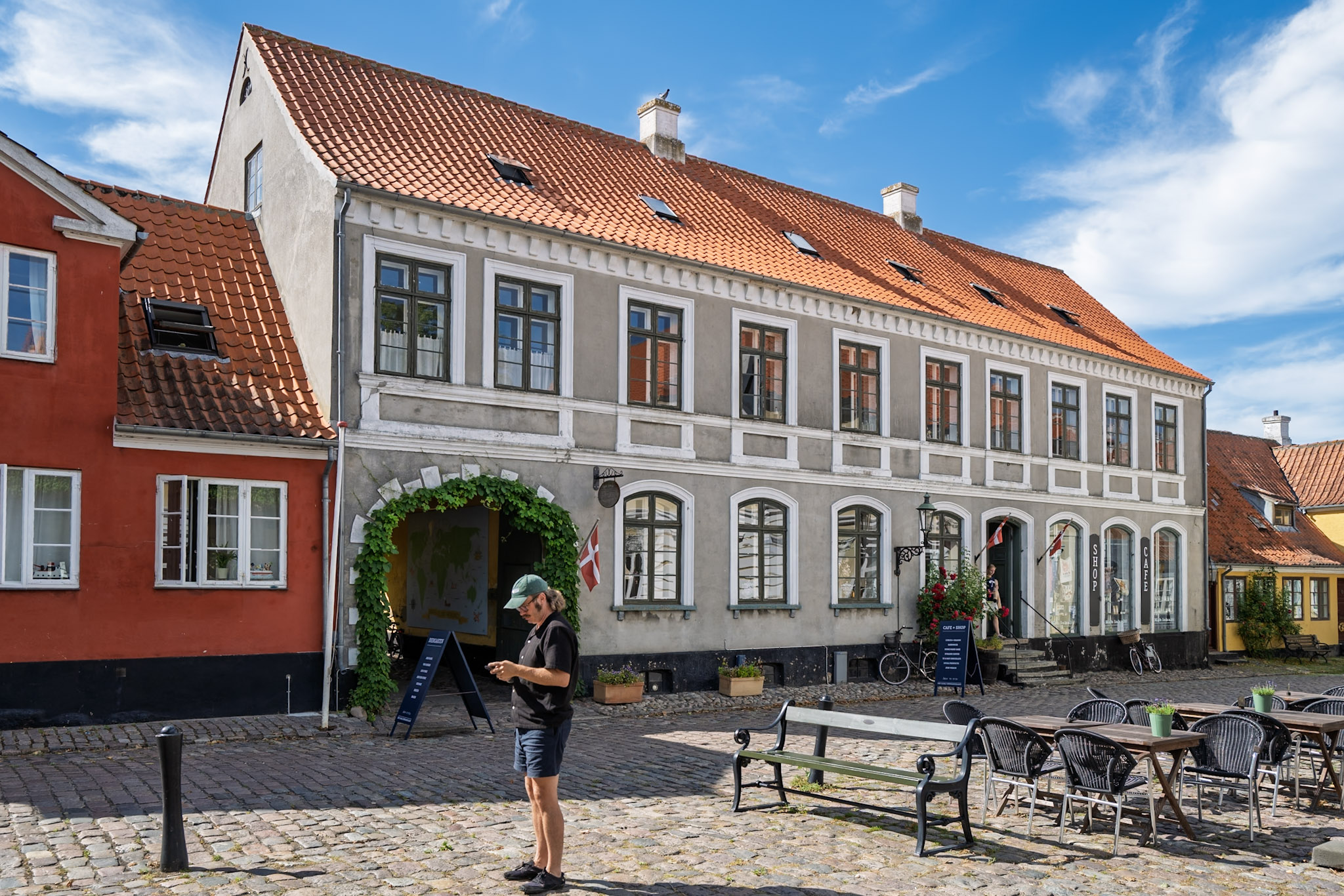
The whisky does less for me. The samples feel hot and rough, including an older one for which I had hoped more time would have helped. It is a limited encounter, with no maker there to discuss it, but on this visit the attractive setting and local story are more convincing than what I drink.
It is useful to have that distinction in mind when we reach Fary Lochan.
The distillery sits among trees at Farre, a collection of small buildings that initially appear to have grown separately. Go below ground and the connections reveal themselves. The cellars join up; pipes carry the process from one part to another. What looks scattered from outside is a working whole.
The stills are tiny, handsome Forsyths pots, recognisably Scottish in shape and almost implausibly small in person. I have seen plenty of copper intended to impress through sheer size. These have the opposite effect. You want to get closer.
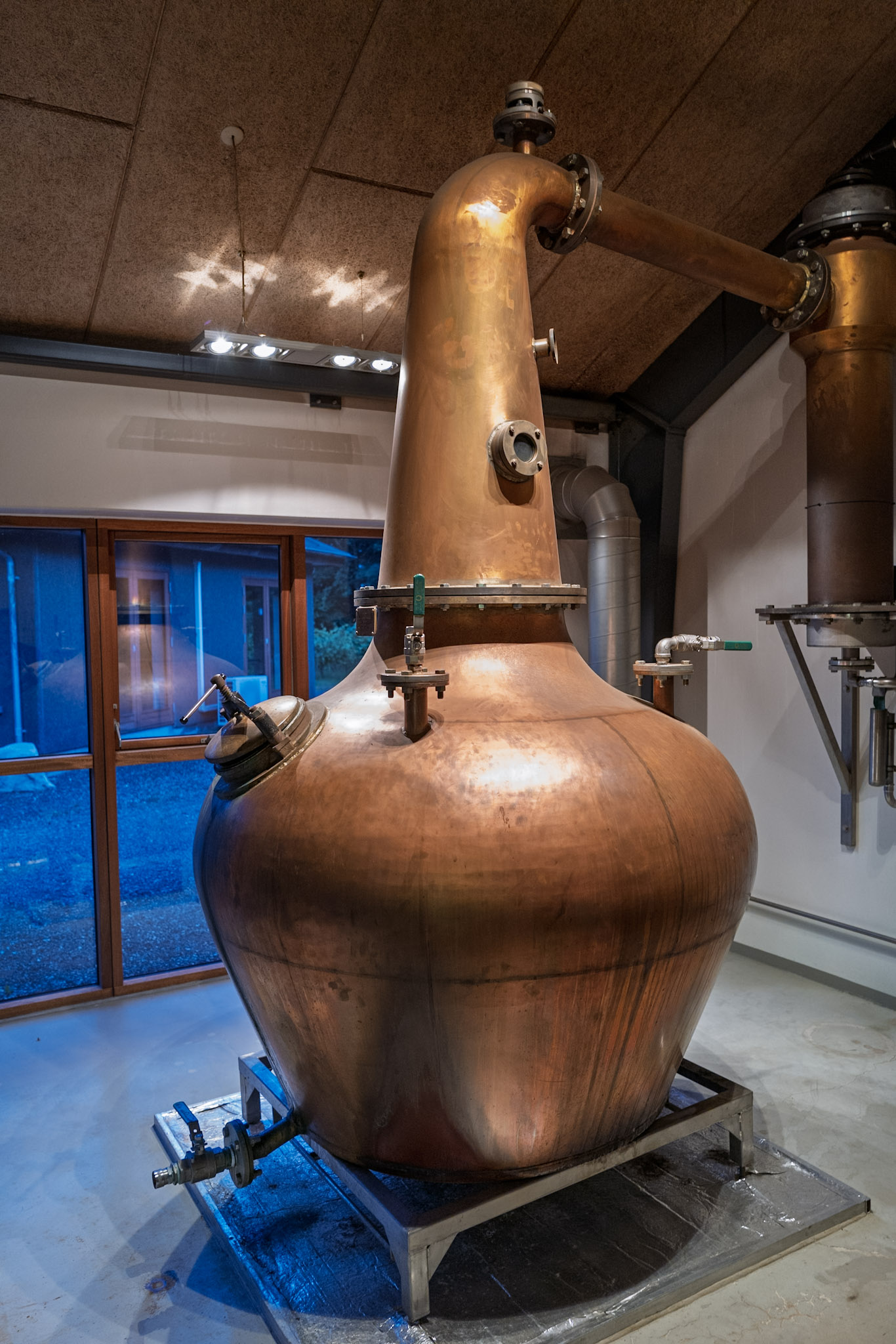
Thomas Smidt-Kjærby tells us how his stepfather, Jens-Erik Jørgensen, decided to build the place. Thomas first heard the proposal in a ski lift in Austria. He had experience of starting businesses, which may have been why Jens-Erik chose him as an audience. It did not produce the desired response.
Thomas thought it was a terrible idea. Denmark knew about beer, butter and bacon. Why whisky?
By the time they reached the top, Thomas believed he had made a convincing case. Back in Denmark, Jens-Erik went ahead anyway.
He bought the forest and set about building a distillery. There was help from Scotland, including Ian Millar, and the considerable commitment of ordering those small Forsyths stills. The first cask followed in 2009. Jens-Erik’s ambition was to make excellent whisky, retire from his work in the Danish tax authorities and create something the family could be part of.
Participation was meant to be an invitation. A role if you wanted one, work you could do together, a place to gather. His son Morten became involved in production. Other members of the family found their places.
Then Jens-Erik became ill. He died in 2016.
For a while, Thomas had understood the family’s increased involvement as temporary. They were keeping things going until the person who knew where it was all heading could return. Decisions could be made in that spirit. If they got something wrong, there would eventually be someone to ask.
The return did not happen. The questions remained.
There is a room beneath the pagoda where Jens-Erik had imagined sitting when he was too old to work. From there he could look out at the family carrying on with the distillery. The buildings, the whisky and the people would all be doing what he had hoped they would do.
He never reached it. When he was still able to climb the stairs, the room was not ready. By the time it was ready, he could no longer get up there. The week planned for the grand opening became the week of the gathering after his funeral.
We are sitting in the distillery he built, talking to a man who would still welcome instructions from him.
“We would much rather have him here with us,” Thomas says.
It would be easy to allow that room to explain everything about Fary Lochan. It would also be unfair to the people working downstairs.
The family have now run the distillery for longer without Jens-Erik than they did with him. They have made it into a business capable of paying people, reaching more shops and releasing more whisky. That required selling things the founder had been content to leave maturing. It required decisions that could no longer be deferred to him.
Thomas knows the place is different now. “We’re doing it the way we think it’s supposed to be done,” he says.
The next morning, Morten Jørgensen is more direct about the daily division of labour. Thomas handles marketing, his sister sales, and Morten production. He joined before his father became ill and has since moved closer to the distillery. This is his working life. He wants sweetness, malt character and the heavy, oily texture his father valued, something that remains in the mouth after a small sip.
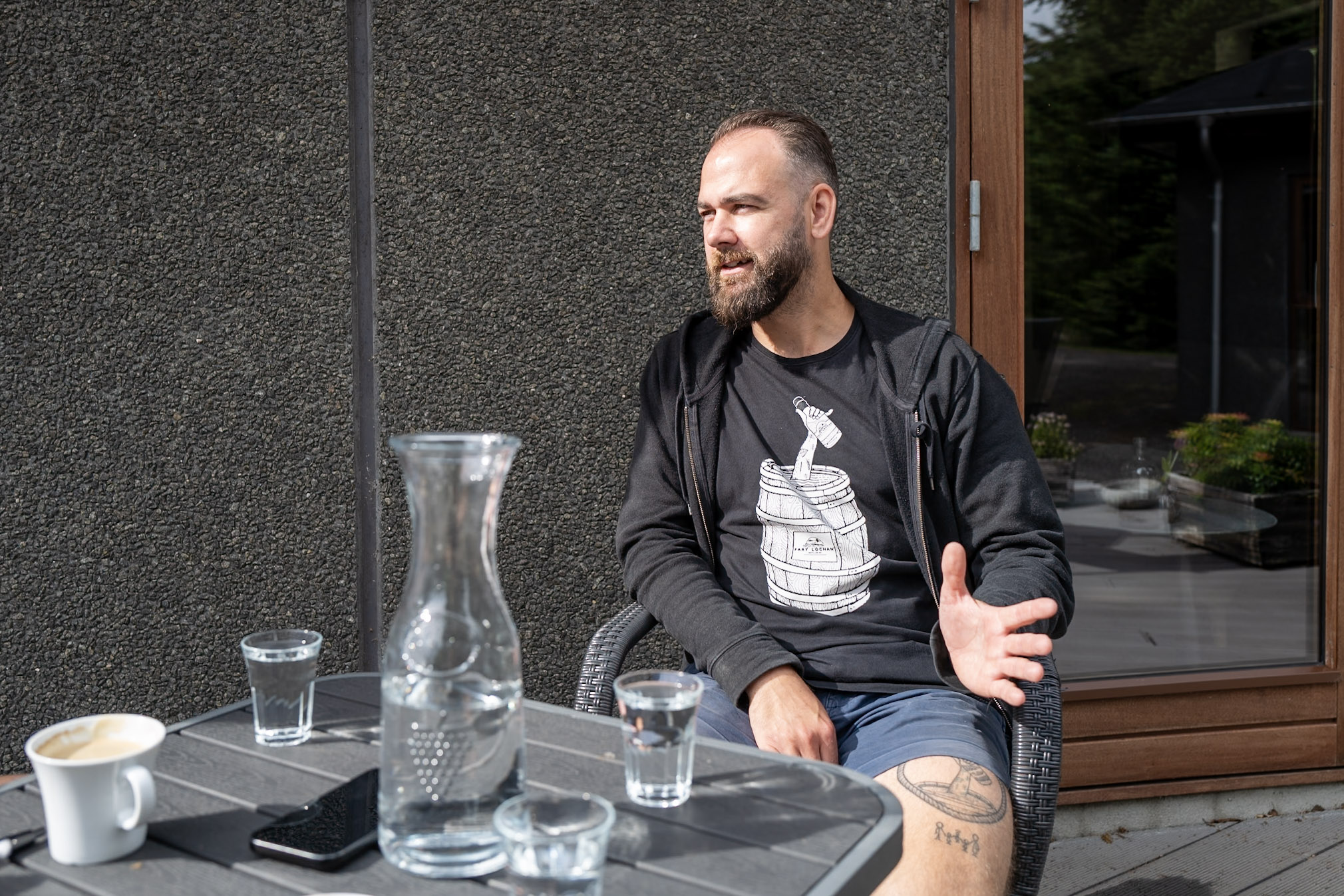
The whisky we drank the night before had that weight and persistence. Ulf and I had stayed up discussing how good it was. It would have deserved the conversation if we had never heard about the pagoda.
There is another inheritance, growing all around us.
Jens-Erik came from Funen, where his mother smoked cheese over fresh nettles. He brought the idea to Jutland and tried it on malt. The wet green plants give smoke rather than a quick blaze; the smell is still present when the smoker is opened for us. It is a rudimentary arrangement, completely intelligible when you stand beside it. Pick something that grows here. Use it to change the grain. See what happens to the whisky.
The result became Fary Lochan’s distinctive smoky style. Thomas remembers a time when they barely thought to mention how unusual the method was. It took an outside marketing agency to tell them to make more of the story.
There is a small embarrassment for my profession in that. We are always asking distillers to tell us what makes them different. Sometimes they have been doing it all day and have forgotten that anybody else might find it remarkable.
By now smoke has begun to mean more than peat. Torben has birch; Fary Lochan has nettles. We will meet beech, heather and Danish bog peat as we travel. None tastes the same. Each begins with somebody looking at a familiar whisky process and considering what the materials around them might do to it.
At Fary Lochan, the connection runs from a mother’s cheese to her son’s distillery and on to the family who still work there. There is no need to make that more poetic than it already is.
What fits in a garage
René Larsen’s route to distilling includes Scotland, wind turbines and the experience of talking to his furniture.
He works in the wind industry and had spent time abroad as a site manager, including in Scotland, where he learned to enjoy whisky. Then Covid left a sociable man working at home. “I started talking to the furniture,” he says. He needed something to occupy him. He began reading the regulations: spirits, tax, fire safety, food standards.
This is one of the less frequently advertised benefits of a whisky hobby. Eventually, a person may read legislation for pleasure.
The conclusion René reached was that he could legally build a distillery in his garage. So he applied for the permits and did it.
Branderiet is a delightfully concentrated operation. There are small stills, controls, tools and bottles, with very little distance between an explanation and the thing being explained. René and Eugen Coulthard have the expansive welcome of people who are delighted that you have come to look. They are also quite happy for Ulf to improve them photographically, if he can manage it.
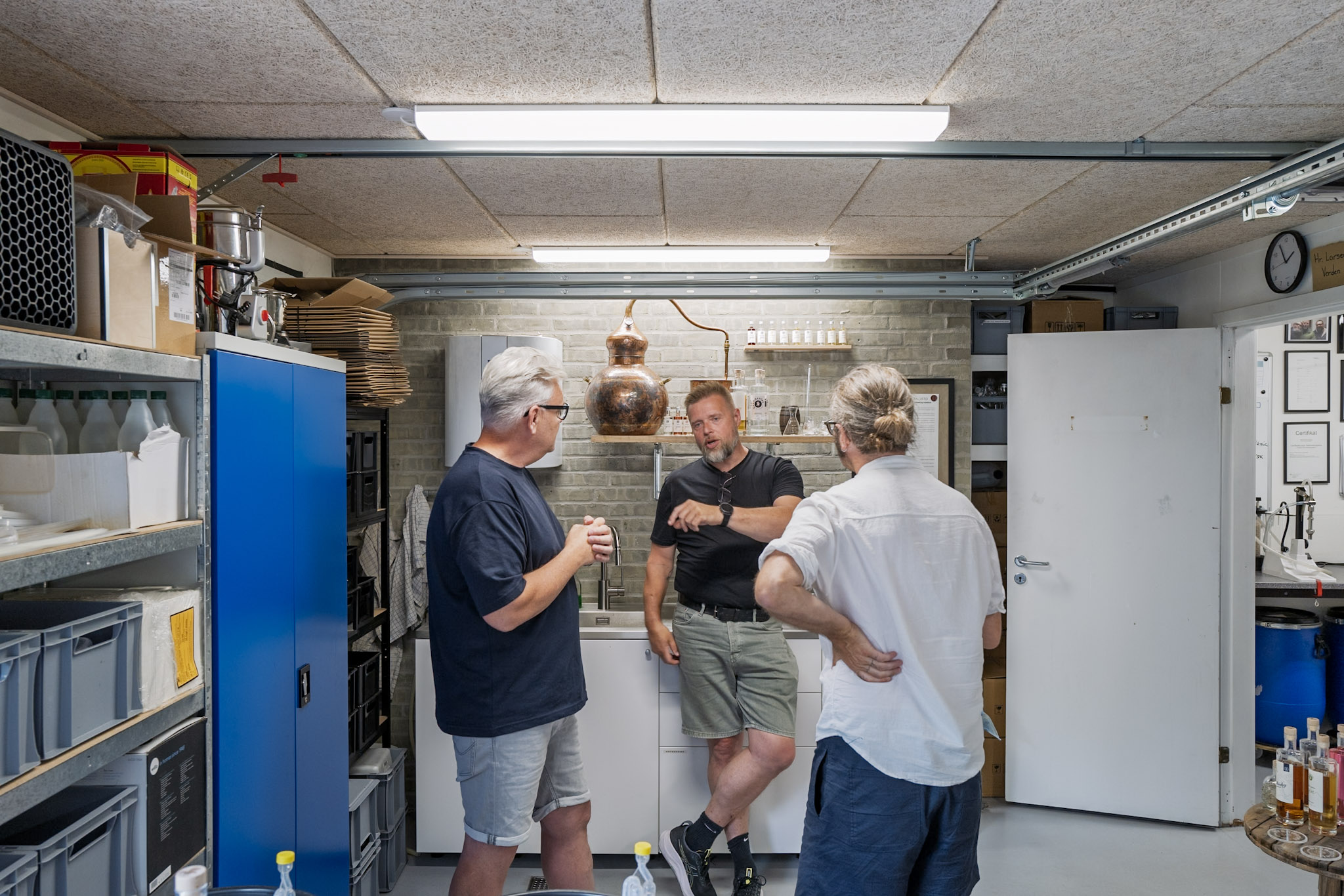
The two knew one another through the local whisky association. Eugen joined shortly after René began. Both still have other jobs. The eventual plan is for this to become their full-time work; for now, money earned by the distillery goes back into spirit and casks.
Gin came first because whisky needed financing. A Chinese still supplied the starting point, but the controls were not good enough, so they built their own. René can hear and smell when the process needs attention. Eugen describes the oddity of working on labels or bottles while René responds to a change in sound from the still.
This is small-scale production in a fairly literal sense. Someone has to pay attention. The elements have to be taken out and cleaned. The equipment has to work in the room available. A supplier able to deliver an impressive quantity of wash is less useful if the last of it deteriorates before they can get through it. Finding a smaller supply becomes an improvement.
It is tempting, after a few visits like this, to turn ingenuity into a flattering national characteristic. I would prefer to keep it attached to the people doing the work. René has made equipment that was inadequate for his purposes useful. That is an achievement without requiring every Dane to be an engineer.
Their first whisky used a small cask seasoned through their own work with Danish honey. A familiar idea, taking flavour from a cask’s previous contents, was redirected towards something they could make locally. They now have more conventional bourbon- and sherry-cask work alongside their experiments. Doing something Danish does not mean that every cask has to announce an unprecedented discovery.
Eugen’s explanation of their position is refreshingly material. They are so small that “we cannot hide behind marketing”. The work passes through their hands, and the distance to the person drinking it is short. They cannot win by producing more than everybody else, or by having a better route into every shop.
René tells us their first cask sold out in two weeks. Then he explains what he has put aside for us: the first bottle.
“I’ve actually taken the first bottle,” he says.
Sharing it lets us taste where they began, while the two men are still close enough to that beginning to remember wondering whether their first cask would be drinkable. They have brought it out for two people they have only just met.
The sheriff arrives by golf cart
At Knaplund we appear to have crossed into a different country without leaving Jutland.
There are American cars, rocking chairs, a saloon, a shop, barrels and Texas Longhorn cattle in a nearby field. The place is initially so empty that the scenery seems to be waiting for its cast. We are shown where to park and told we will meet people at breakfast.
For a while, that is that.
Then Karl Povlsen arrives in a cowboy hat on a golf cart.
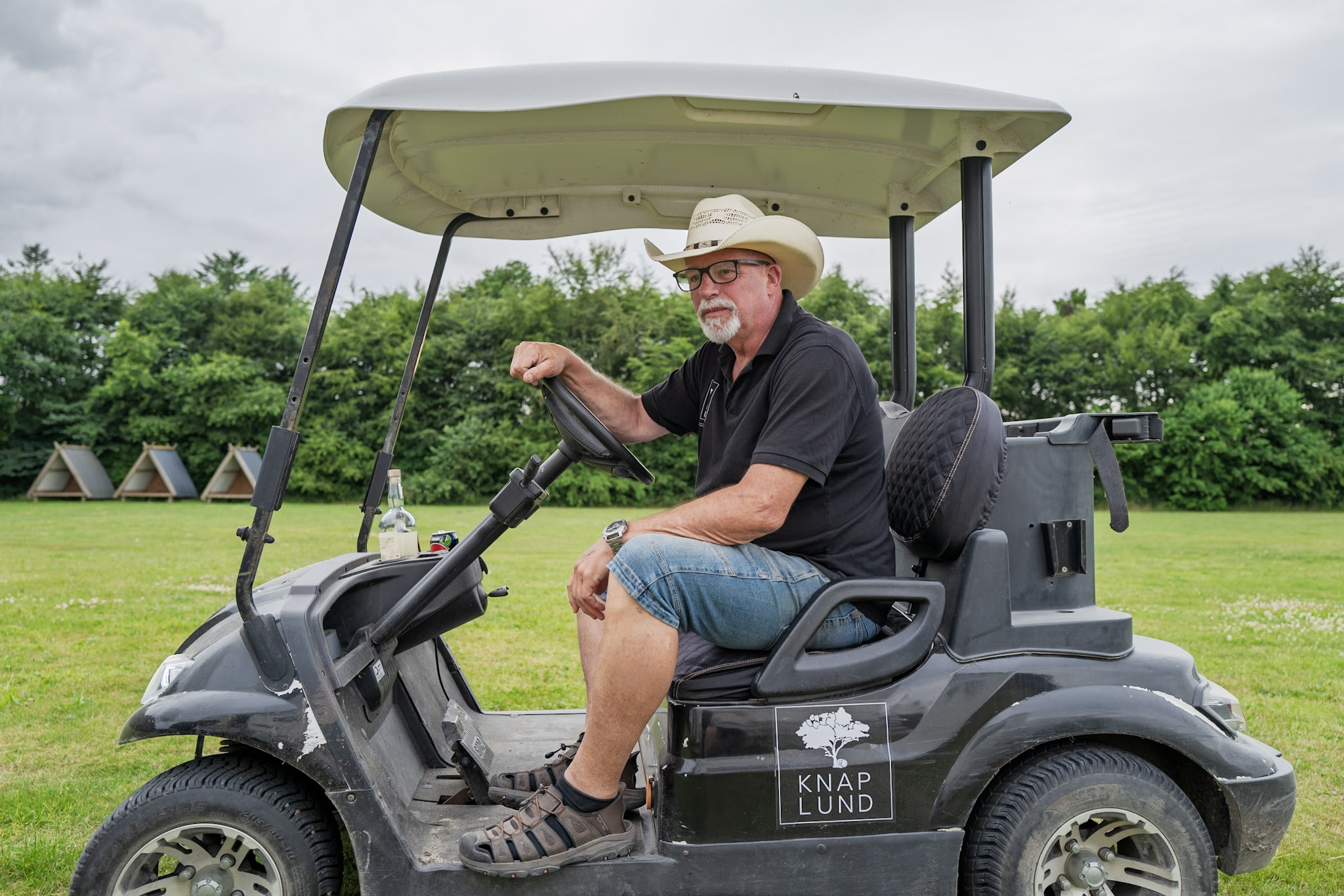
I am not sure that I have ever been more relieved to find that a man looks exactly as the situation requires.
Our conversation begins with a little mutual caution. Knaplund makes spirit, but it also imports American whiskey, and Karl seems to anticipate the kind of whisky visitor who will regard that as a disqualification. I have come to understand what people are doing. It would be a fairly poor start to take against somebody for failing to be a Scottish-style malt distiller.
Soon the golf cart is coming back with whiskey. There is wheated bourbon, and an experiment involving a small stave and triple sec. Then there is food: ribs, potatoes, corn and whiskey sauce. A night that might have involved looking across a field and finishing yesterday’s bottles becomes an evening with an unexpectedly attentive host.
A cat later puts its face in the sour cream. Ulf, it turns out, is considerably less fond of cats than he is of good cigars. The cat is not interested in his opinion.
The next morning, the apparent fantasy set begins to disclose a fairly practical business.
Karl’s inspiration came from a visit to Jim Beam while travelling for work. He wanted to bring something of the American distillery experience home: the spirits, the hospitality, the opportunity to look around and have a good time. He and Mathilde Ingvardsen, whom he knew through their previous work, found a former school with enough buildings and land to accommodate the idea.
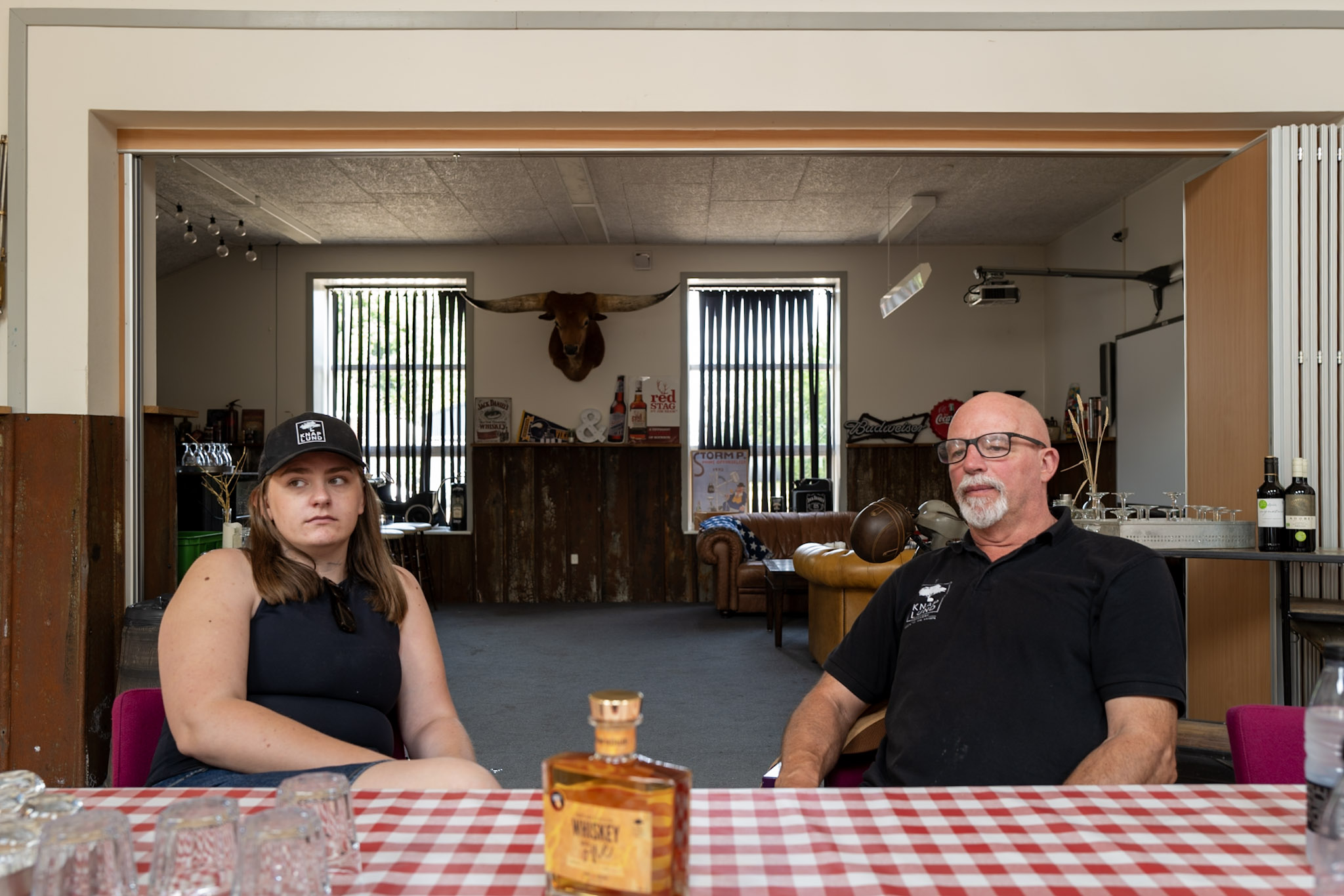
Their original ambition was modest: a few people making and selling a manageable quantity through their own shop. The demand for gin, especially during the pandemic, changed that calculation. The business expanded. There are now products for people who already love whiskey and products for people Karl hopes might be persuaded to try it.
He talks about honey whiskey as a way in. Someone reluctant to drink bourbon neat may enjoy that, become curious and move on. A cream liqueur or a caramel-flavoured product can be an end in itself, too. Their customers are not obliged to complete a course in becoming somebody else.
I like that openness. Whisky can be an unnecessarily forbidding pleasure, guarded by people who have confused knowing something with owning it.
Still, openness to drinkers cannot excuse muddling what is in a bottle. American whiskey brought to Denmark and whisky distilled at Knaplund have different origins. Both can be enjoyable. A Danish whisky identity means very little if the customer cannot tell which work was done where.
Karl pours the first Knaplund-distilled whisky release, brought out from the bottles he has retained. It is built along bourbon lines, using maize, rye and malted barley, with new casks. I find it well made and coherent in its intention. America supplies the inspiration; the making happened here.
The grain is a further complication. Karl is explicit that the maize for this whisky was imported. Growing maize for grain is a different proposition from growing it for silage, and the Danish crop cannot simply be assumed to provide what he needs. Here is a maker who belongs in the conversation while exposing a practical limit to one of its most appealing ideas.
The manifesto allows grain of other origins when clearly disclosed, including under its provision for certified Danish grain from 2030. Its seal belongs only on qualifying products. A distillery’s membership does not make everything it sells Danish whisky.
That distinction will matter when we speak to Hans Martin Hansgaard at Stauning. He is pleased Knaplund joined. Agreement on the bottle’s promise is more useful than requiring everybody in the group to run the same kind of business.
Karl’s son is developing rum as his own area within the enterprise. The containers used for maturation embrace swings in temperature. The shop allows visitors to taste before buying. The shelves of Karl’s private American whiskey collection make the source of his enthusiasm abundantly clear.
This is a busy place trying to find customers through several doors. The cowboy hat is part of it, but you would miss most of what is happening by stopping there.
Twenty-four small stills
At Stauning, the buildings appear to have settled the question of scale before Hans Martin Hansgaard begins speaking.
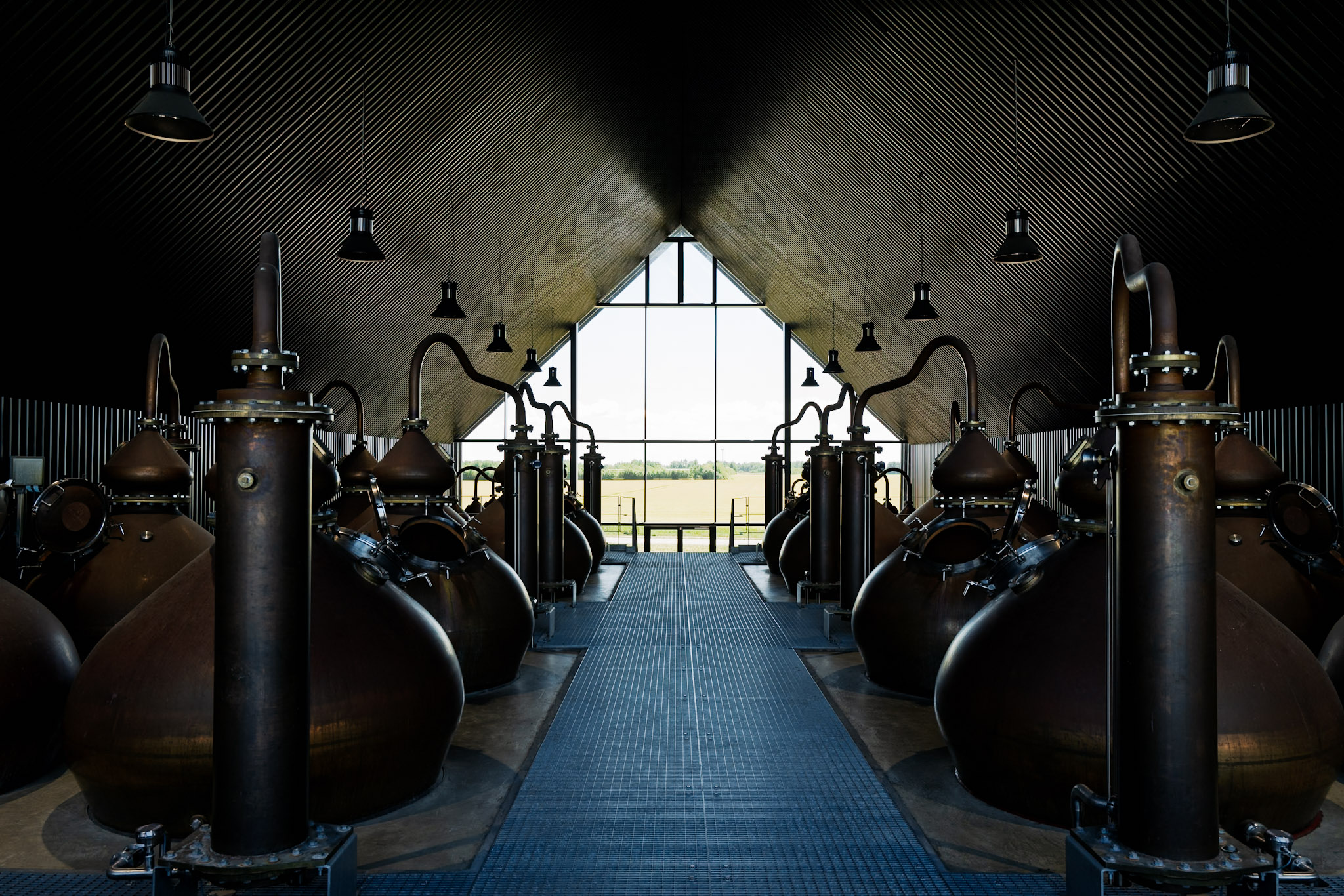
The gables, the long malting floors, the ordered copper and the warehouses belong to a distillery conceived with considerable ambition. Ulf has space to photograph repetition: rooflines, stills, rows of casks. It is a different visual language from a garage full of things that have been made to fit.
Hans begins by taking us back to a butcher’s shop.
Nine friends and family members established Stauning in 2005. A radio programme about making whisky had prompted one of them to consider the water, grain, climate and peat around the village where he grew up. The ingredients did not seem so impossibly foreign. They could buy some small stills and try.
Several of the group were engineers. Not all were whisky obsessives. The attraction included doing something together and seeing whether they could make it work. They settled on local materials and doing the work themselves, including malting. Those principles were easier to announce than to operate.
When one founder was getting up at night to turn the grain by hand, the answer could have been to buy malt. Instead, they built a machine to turn it. The problem was a person’s working life; the solution allowed them to keep the process they wanted. Hans regards that malt turner as one of the most important things they ever made.
The tour gives the machinery a history. It becomes possible to see how the present distillery grew out of inconveniences in an earlier one. Working with rye produced a sticky problem in mashing. Equipment was adapted. More production required more malting space. The distillery grew by solving the next thing that stopped it growing.
Then investment associated with Diageo made a much larger step possible.
The obvious way to get more spirit would have been to buy a small number of much bigger stills. Stauning bought twenty-four small ones instead. They wanted to retain the direct heating, the relationship between the liquid and the copper, and the character they believed those things helped create.
“We decided, okay, we cannot scale up in that usual way. We are scaling up by building many small units.”
There is a useful answer here to anyone who mistakes the visible size of a distillery for a complete explanation of its whisky. A large building can contain a repeated small process. Engineering can preserve a choice that would otherwise become too laborious to sustain.
Hans, who used to teach, has the patience of somebody accustomed to explaining how one thing follows another. He also knows the resentment that can attach to a company which has grown beyond the group it once belonged to. Some drinkers see wider distribution and lower prices and assume the whisky must have become cheaper to make. He insists the important production choices remain.
But the scale has also created obligations that good spirit cannot discharge on its own.
On 1 July, Hans tells us the company has gone from sixty-five people to thirty in roughly a year. Production is running at about a tenth of its full rate. At capacity, he says, they would be filling fifteen barrels a day. The cost begins before there is whisky in them. Somebody has to pay for the wood.
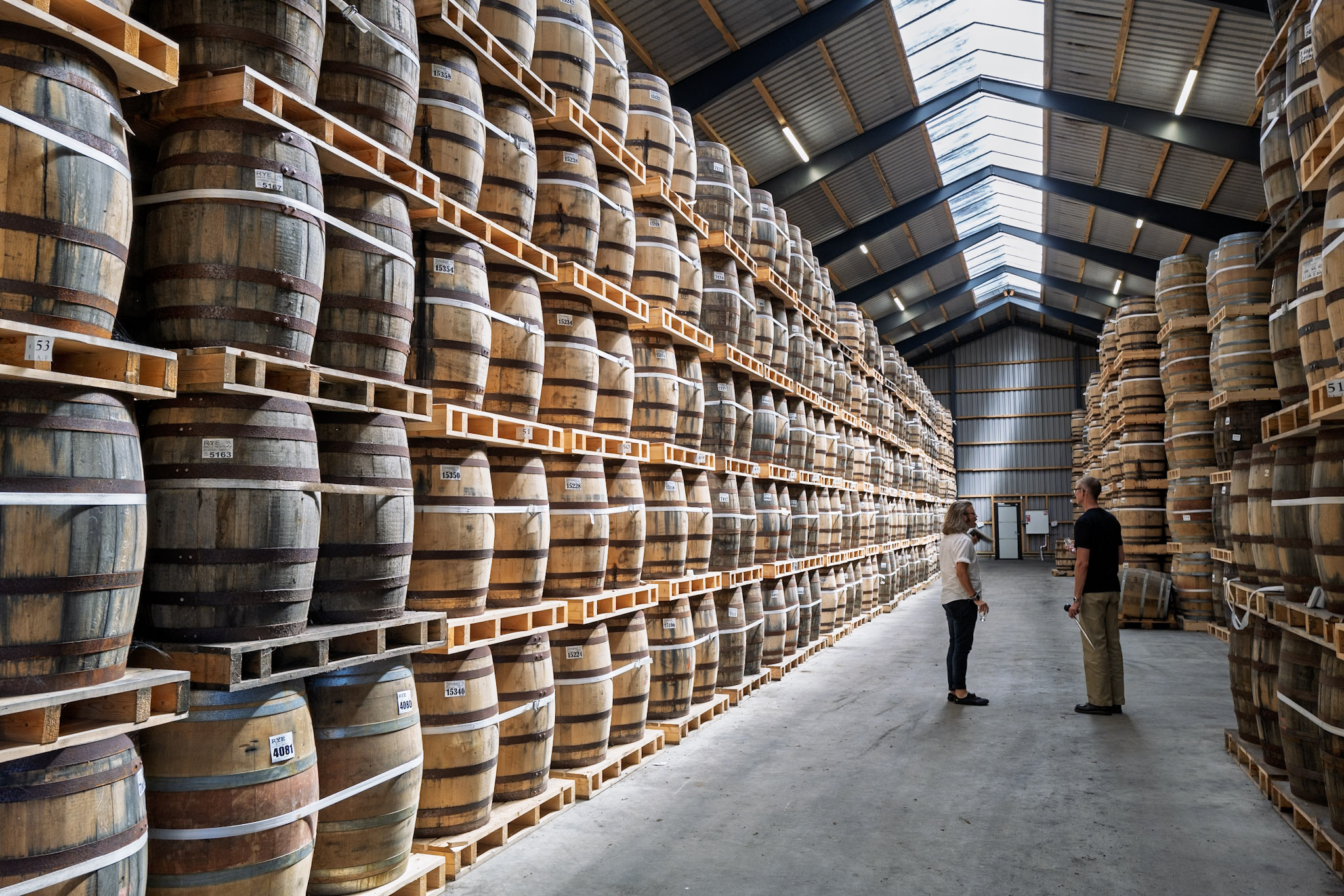
The figures sit awkwardly beside the architectural assurance outside. They should. We are looking at a distillery built for a level of activity that its present circumstances cannot support.
This is not the same as saying it has stopped making whisky, or that the whisky has failed. Hans describes a company adjusting its business while continuing to sell and develop its spirit. The difficulty is how to operate a facility of this scale in the market actually available to it.
He talks about being independent again, about slowing down and knowing the people in the business. Parts of the expansion had taken the company further from the founders’ daily lives. The smaller team feels closer.
“It feels really, really good to know everyone in the company.”
I believe him. I also cannot turn a reduction of more than half the staff into a cheerful story of rediscovery. There are working lives behind those figures.
Stauning makes the commercial question at Nyborg harder to dismiss. The problem is not simply whether a founder can produce whisky good enough to justify the project. There must also be a way to sell enough of it, at a price that pays for the choices that made it good.
Hans wants Danish whisky to be recognised as a category. His ambition includes something modest enough to sound almost comic after the buildings: a shelf at The Whisky Exchange shops devoted to Danish whisky. Enough choice, quality and recognition for a retailer to give the country its own space.
That shelf would spare every producer the work of beginning the explanation from nothing.
The shared explanation has not always come easily. Hans remembers early whisky shows where the Danish distillers barely said hello. Working together on the manifesto changed the relationship. He talks about the pleasure of meetings with people who had previously been treated as competitors. Cooperation has been built, rather than issued with their passports.
There is no promise that it will remove the competition. Each still has a business to keep alive. But a drinker who has enjoyed one Danish whisky may become more willing to try another. The first bottle carries a little of everybody’s reputation.
I leave with a stronger sense of what the manifesto might do, and a much weaker appetite for calling anybody’s future inevitable.
Before the barley reaches the mill
At Thy, Jakob Stjernholm takes us into a grain silo.
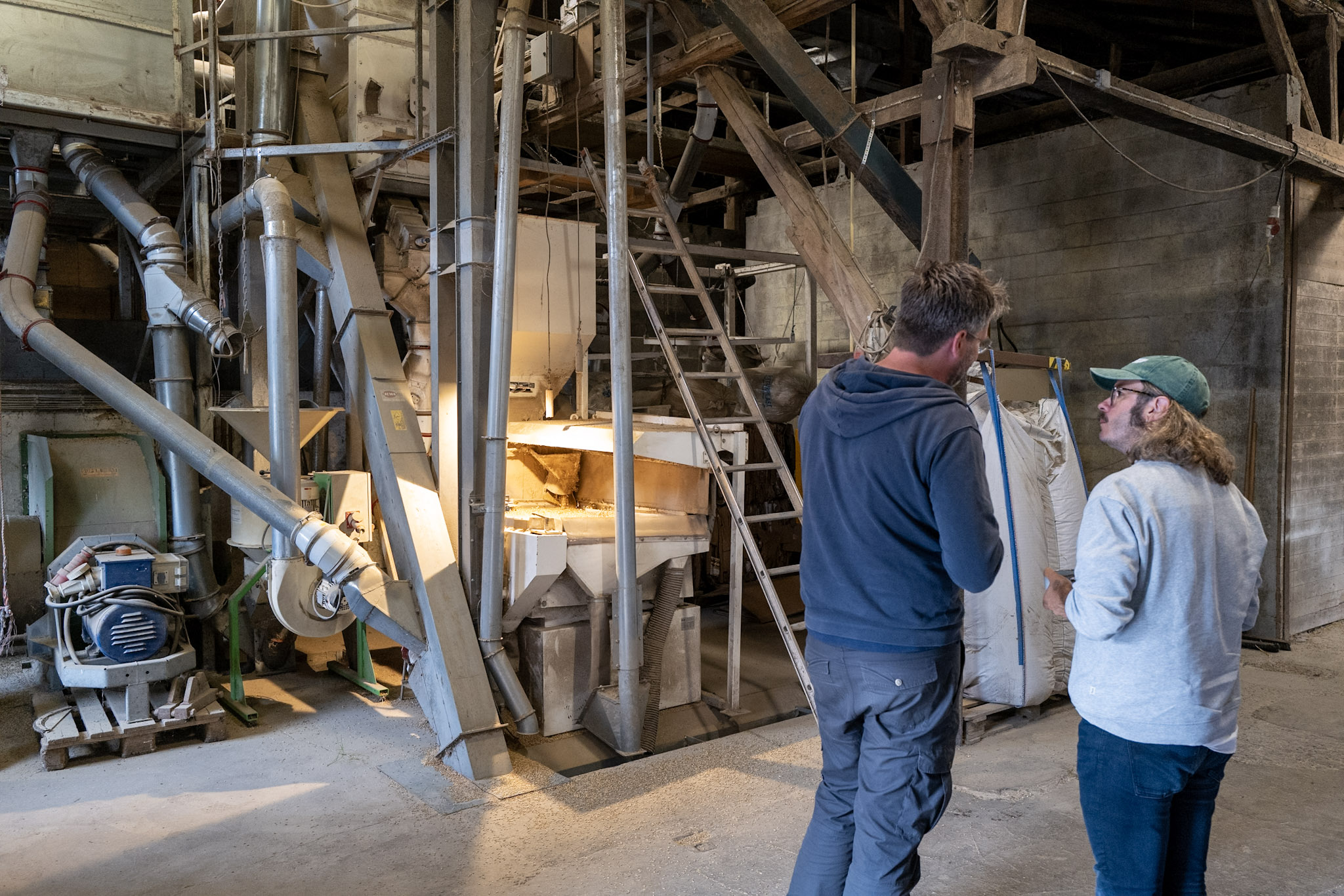
It is almost empty, which allows us to stand inside and look at the floor through which air moves to dry the harvest. Before we see a still, there are silos, cleaning and sorting equipment, separate grain batches and an explanation of how to keep something living from spoiling in storage.
This is not usually the opening act of a whisky tour.
Jakob knows that. He knows the familiar route that begins with the barley arriving at the mill, then proceeds towards copper. The mill is a convenient place to start because much of the awkwardness has already happened somewhere else.
At Thy, the awkwardness is the point.
If you want to know what a particular grain variety contributes, you need to grow it, harvest it, dry it, clean it, keep it separate and get it malted without losing its identity. The ordinary commercial system is very good at handling large quantities efficiently. That does not mean it is arranged to preserve a few tonnes of something unusual for a curious distiller.
Jakob tells us about his father-in-law’s work reviving old barley varieties. The beginning could be a handful of seed from a gene bank. Sow it by hand. Harvest it with scissors. Sow the larger quantity the next year. Repeat until, perhaps six or seven years later, there is enough for a proper batch.
Only then do you arrive at the maltster and discover that your hard-won quantity is inconveniently small.
There are forms of patience in whisky that have very little to do with a cask.
The equipment around us is an answer to that problem. Thy can work with small batches, keep varieties apart and make malt for its own whisky as well as for other distillers and brewers. The malt house came before the present distillery. When they fitted the distillery in, it occupied a corner of the larger grain project.
Jakob talks quickly and in detail, moving from airflow to germination to flavour and back to the business of persuading somebody to build a machine. At one point, after a particularly fluent account of the system, he reminds us that he studied political science.
He had worked in government in Copenhagen. A career, a house and a perfectly serviceable life were already in place when the family began discussing the farm’s next generation. The whisky, initially a small project involving his father-in-law and Nordisk Brænderi’s Anders Bilgram, had become something the family gathered around and encouraged.
Thinking about taking over the farm allowed the dream to expand: perhaps they could do everything from field to bottle in one place. Jakob moved here in 2016. Building the malt house and distillery followed; the family succession on the farm was completed in 2019.
Now the former political scientist can explain why the diameter of a malting drum reflects what a local fabricator’s machinery could accommodate. They found out what the people around them could build and designed from there. It is difficult to give local production a more literal meaning than that.
The grains do not remain abstract. We chew them. Caramel malt is hard, sweet and roasted. Rye brings a different kind of breadiness and spice. Jakob talks about older barley varieties giving citrus, earthiness and oily new make, unlike the sweeter, more familiar character of modern malt. These are his sensory distinctions, developed through making and tasting; the infrastructure gives him a chance to test them.
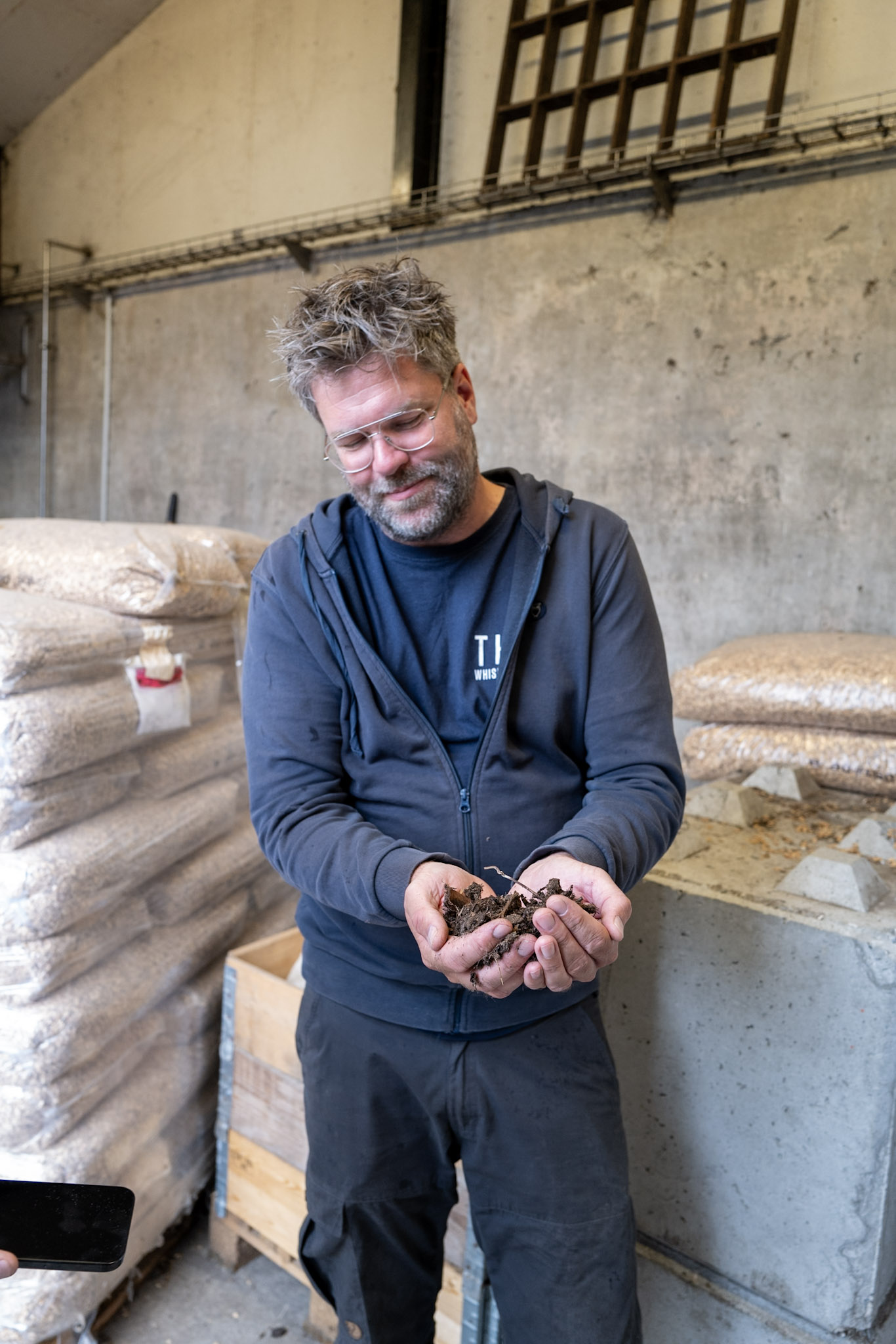
Lower yield is part of the bargain. An old variety cannot be expected to provide the same output as a modern one and then be dismissed as too expensive when it fails. If a distiller wants a farmer to grow it, somebody has to accept that cost.
“You have to take responsibility,” Jakob says.
It is an excellent corrective to the apparently innocent request for something more authentic. You cannot ask a farmer to carry the expense of your differentiation while you collect the romance.
None of this makes Jakob indiscriminately enthusiastic about every claim made for barley. When I ask about terroir, his answer is a qualified no. He is unconvinced that the composition of an individual field’s soil makes a large, useful difference to barley flavour in the way he understands it to affect wine. For him, the bigger, more evident distinctions are between grain varieties.
I am pleased to hear the reservation. A person can be deeply committed to bringing farming into whisky without agreeing to every attractive proposition about the taste of a place.
Nor does he dismiss maturation. Casks matter enormously. He simply does not want them to supply all the interest. A comparatively familiar set of bourbon and sherry casks can leave room to recognise what changed before the spirit reached them. His objective is to build flavour early enough that more wood is not always needed to make the whisky more interesting.
Thy did not introduce its three-part core range until 2024, years after the first small batches. The malt, rye and beech-smoked styles emerged from the work. They were not a diagram imposed on the farm before anybody knew what it could make.
That time has been useful. Jakob is wary of deciding too early what a young distillery must be. An identity discovered through practice can turn out more interesting than the one that made sense in the original plan.
He is now engaged in another kind of work: explaining all this to people who will never come here.
A visit makes the proposition unusually easy to grasp. You stand in the silo, chew the malt, look at the fields and taste the whisky. A shop shelf elsewhere has none of those advantages. The bottle must earn attention among familiar names, communicate enough of the reason for its existence, and then deliver pleasure without requiring its purchaser to complete our morning’s tour.
Jakob thinks there is a wider opportunity in getting drinkers to care about grain. He also knows the argument will travel further if companies doing this work succeed. Being right about the importance of an ingredient is not sufficient distribution.
At Nyborg, I had looked at the stills and thought about the scale of the commitment. Here I have spent much of the visit looking at what must exist before a still is of any use.
A man who took a boat
Anders Bilgram is explaining how he travelled around the Arctic in a six-metre open boat.
We are upstairs at Nordisk Brænderi, in a warm, wood-lined room that encourages sitting down and taking rather longer than planned. The space had been shaped around his wife’s ambition to blow glass before it became part of his.
The journey took eight summers across ten years. Twenty-six thousand kilometres, two outboard engines, a route around the top of the world. He mentions destroying engines through bad fuel in Russia. I am beginning to suspect that setting up a distillery might, for Anders, have represented a comparatively settled phase of life.
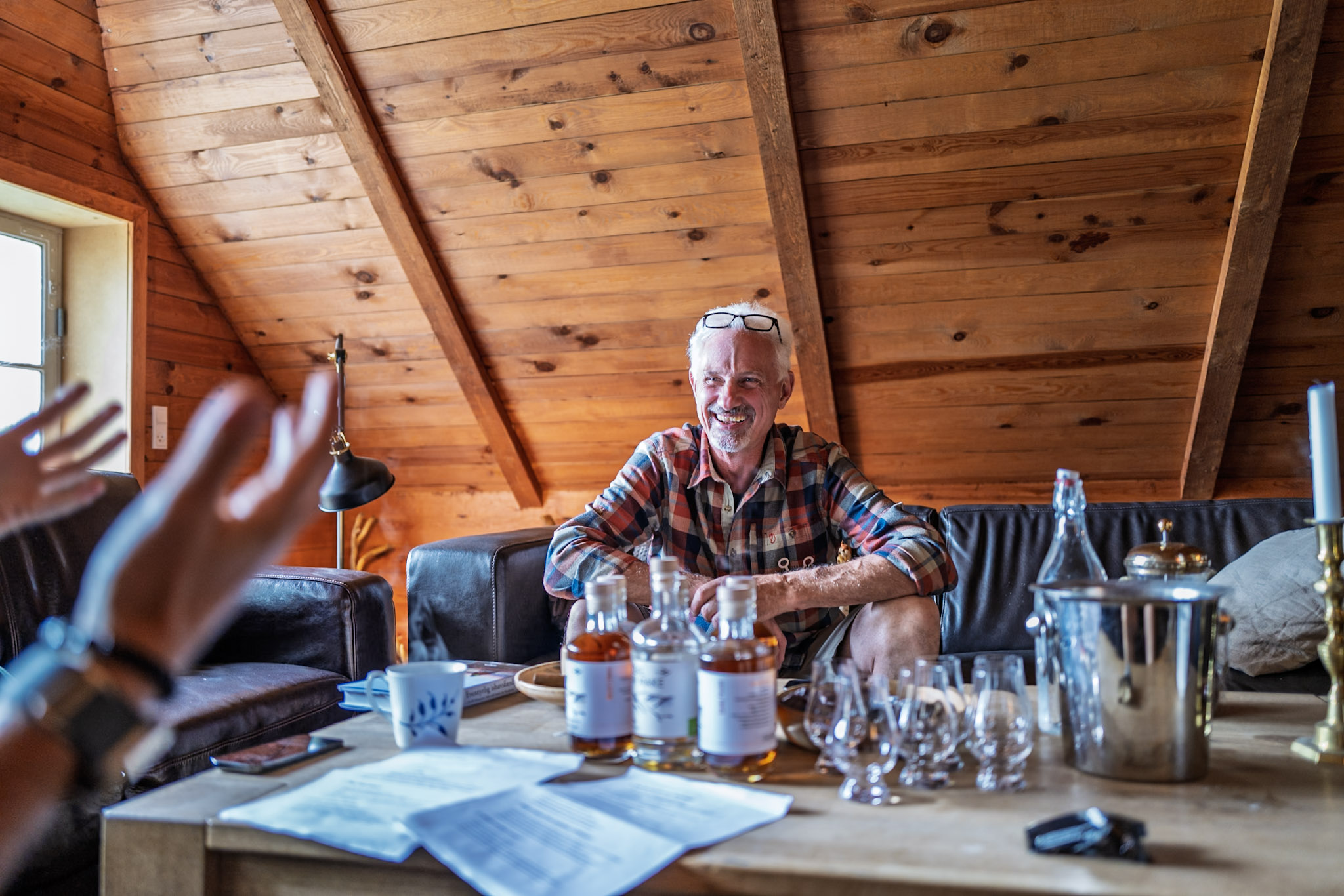
He does not present the journey as a motivational anecdote. The Nordic world he moved through supplies a sense of who he is and what he wants to make. Local plants, grain and climate belong together in that understanding.
“If I get an idea, just try it, not a lot of hesitation.”
Anders went on a malting course. René read regulations. Torben went to Scotland. Their willingness to begin has been followed by the effort of learning how to continue.
Anders is part of more than one story we have heard. He made the early Thy spirit in partnership with Jakob’s father-in-law before the businesses went their separate ways. The national scene is small enough for one person’s equipment and experience to appear in another family’s beginnings.
At Nordisk he now has his own barley. The idea that Danish grain could be sent abroad to become a whisky he admired had helped provoke him into trying it here. There is peat and heather, fruit spirit and gin, and the advantage of equipment he can adjust to what he wants to make.
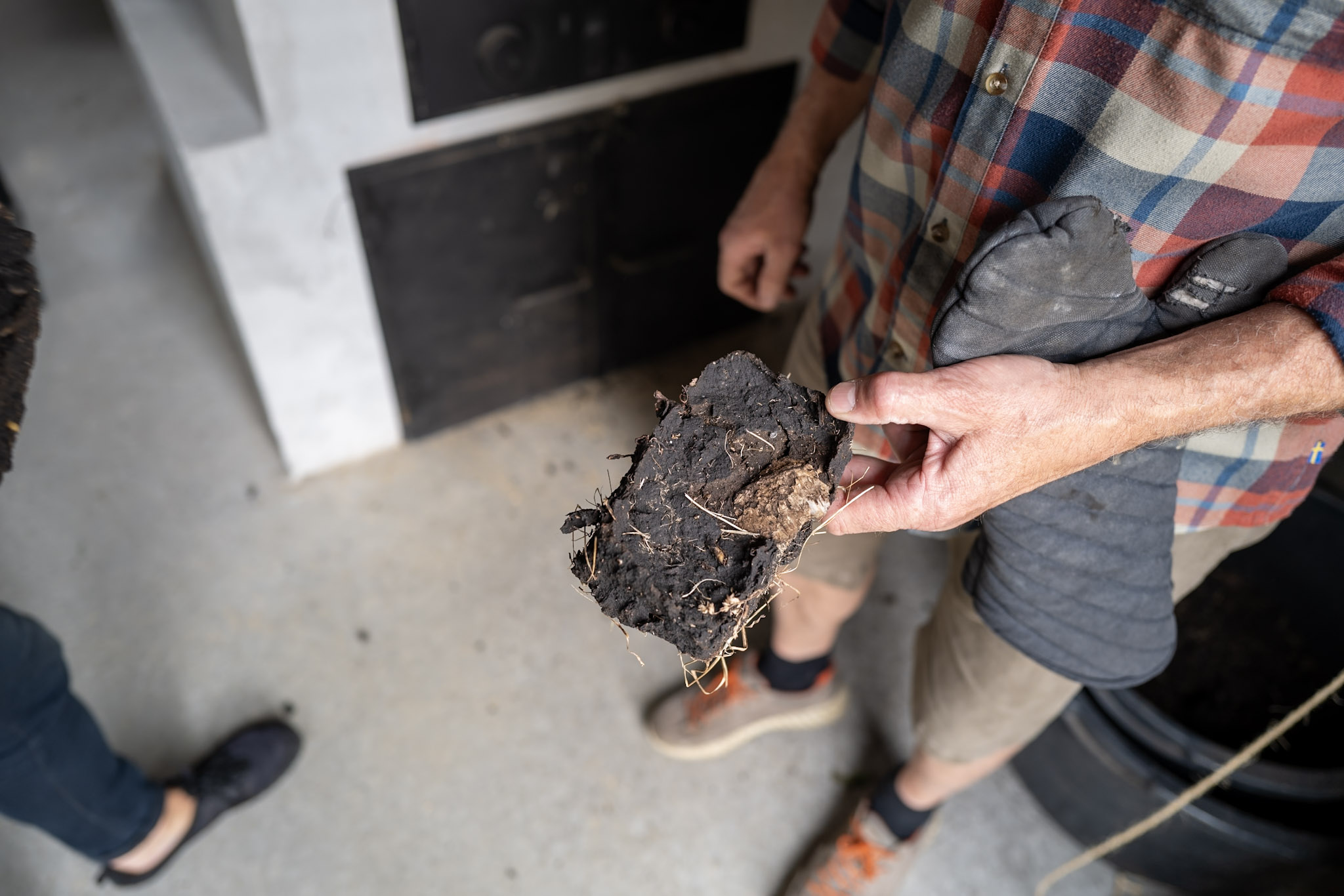
He uses a wine yeast alongside a whisky yeast, drawing on his experience with apples. The fruity notes are the attraction, even if that choice does not maximise alcohol yield. When we taste, the fruitiness is immediately apparent. It is not something I have to persuade myself to find after an explanation about fermentation.
His warehouse follows the local weather rather than a tightly controlled environment. He describes winter cold and summer heat, the losses from the casks and the resulting limits on how long some whisky can sensibly remain there.
The weather has been making itself apparent to us, too. We have been hot enough in the van to abandon any illusion of comfortable touring, then cold and shaken by wind. But climate is not a single national flavour. Nyborg’s enclosed warehouse, Knaplund’s containers and Anders’s storage do different things with the conditions outside. A country’s weather enters a whisky through particular buildings and decisions.
When I ask Anders whether Danish whisky already has a distinct character, he declines to invent one for my convenience.
“Not yet. I don’t think so. I think we go very much in different directions.”
He is interested in the possibilities that remain open. So am I, increasingly.
The visit extends into food, conversation, gin and tonics, and cigars. Anders gives us each a copy of his book, with different personal messages inside. Ulf and I have been allowed into somebody’s working life and then into rather more of his evening than any professional obligation required.
I am grateful for it. I also know how easily this sort of generosity can improve a writer’s view of the world. The whisky needs to remain good when the host is no longer in the room.
Two names at one address
By Friday, the idea that every distillery must express its founder is becoming more complicated.
At Kolding, Trolden and Mosgaard occupy the same site. There are two sets of stills, two whisky identities and a team managing the practical consequences. Thirteen distilleries do not, in this instance, require thirteen separate addresses.
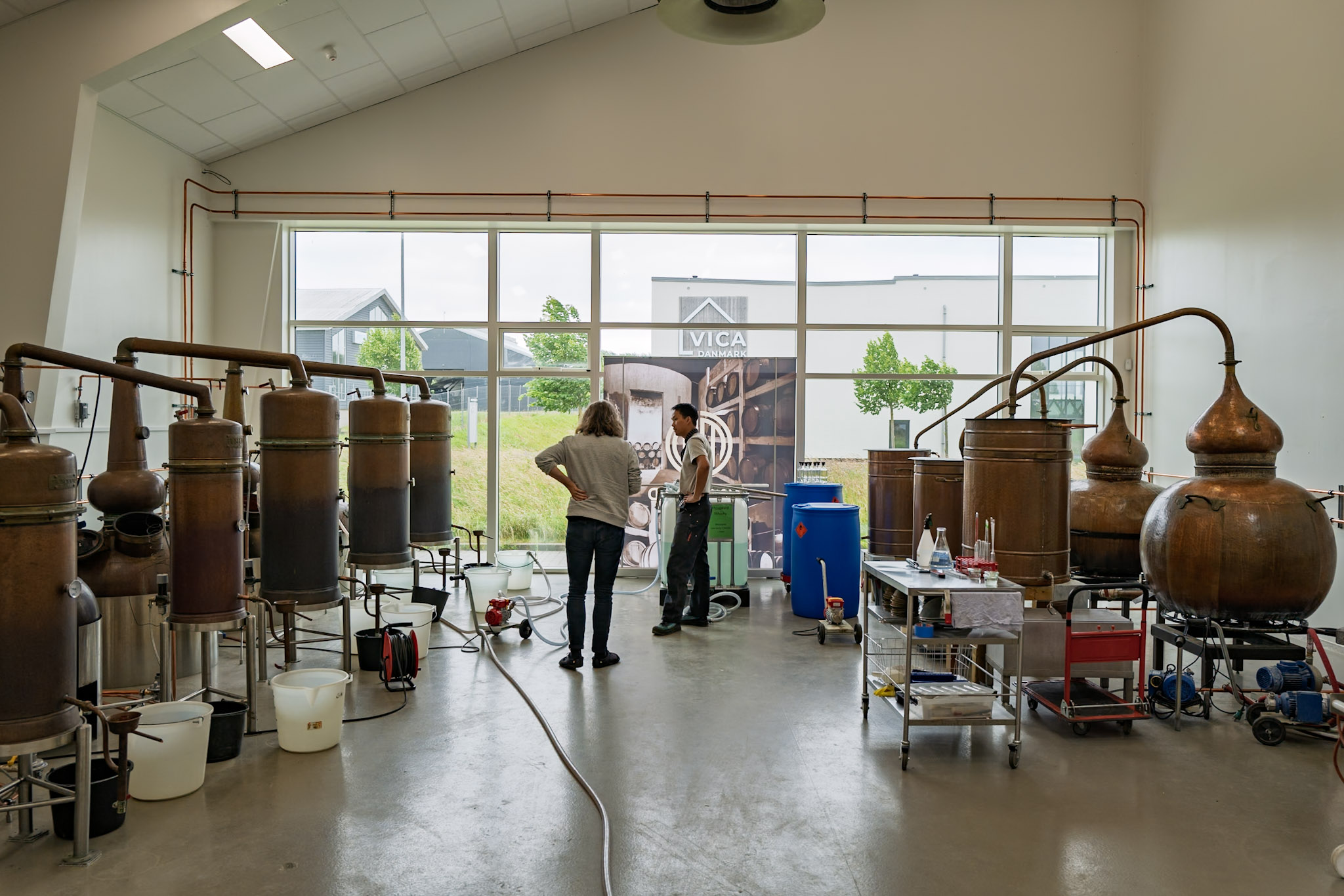
Simon, a production assistant, takes us through the stills, the transfer of liquid and the work of making cuts. His working day involves lighting burners, watching the process, measuring, smelling and tasting. He is also careful about which questions belong to somebody else. When I ask about the intended character, he makes clear that he is working to a recipe and offers to bring in the person better placed to discuss its design.
I find that reassuring. We have heard plenty of founding visions. Here is a person whose responsibility includes making somebody else’s intentions work consistently on a Monday or Tuesday.
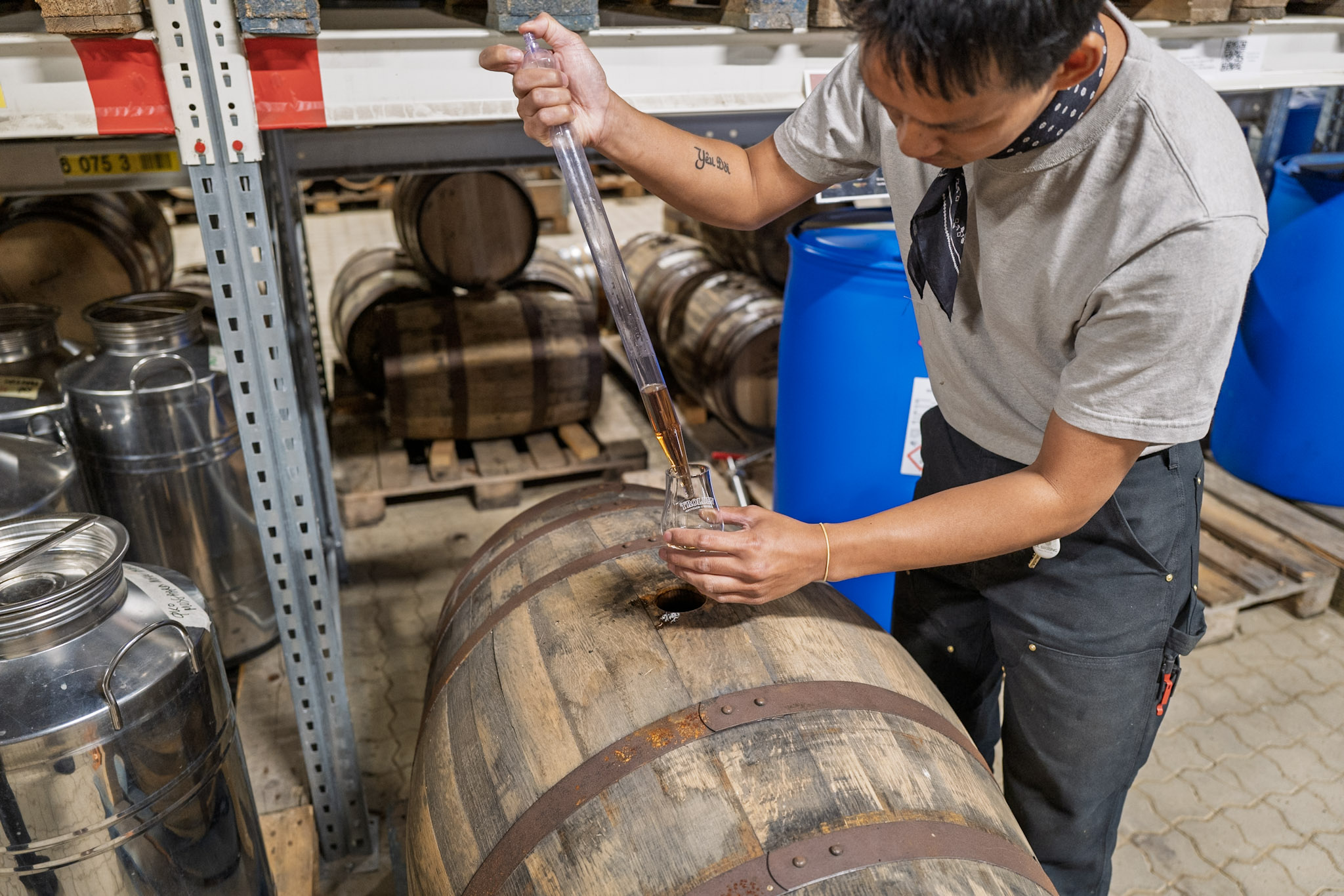
Trolden began as a Kolding brewery in 2005, adding distillation in 2011. Its founder’s enthusiasm for steam railways survives in labels that resemble old tickets. The whisky has its own history of small stills, expansion and a move from tighter premises in town.
Mosgaard began elsewhere. Jes and Gitte Mosgaard founded it on South Funen in 2015, combining Scottish inspiration with organic raw materials and small-scale production. Under new ownership it moved to Kolding in 2025. The copper pots came with it, along with casks and the expectations of people who already cared about the whisky.
Sharing a building does not make those histories interchangeable.
Mads Christian Hansen describes the effort required to bring the equipment and stock together. Warehouse layouts had to change. Stills had to be fitted into a room already doing another job. A business with more whisky needs more than a second name on the door.
He also talks about finding a useful scale for experimentation. Small trials can be poured at tastings or the Friday bar. Feedback can help decide what deserves a larger run. There is room for play, provided the main business is organised well enough to support it.
That is a different account of freedom from simply making everything you can think of. A good idea needs somewhere to be tested, and a point at which somebody decides whether to keep paying for it.
Jesper Krog joins the conversation and brings it back to the distinction in the spirit. He describes Trolden as the oilier, more intense of the two. The mash and production choices remain different; the intention is to preserve recognisable identities rather than dissolve them into a common house style.
The Mosgaard tasting puts cask differences beside one another. A series built from a common base, moved into different sherry casks, allows the wood to become the variable. After Thy’s long consideration of grain, this is a useful shift of attention. There are several places in the process where a whisky can acquire its interest. A country does not have to nominate one and prohibit the others.
I am also struck by what the site says about continuation. Fary Lochan’s family have carried a founder’s work forward. Here, a different team is carrying work made elsewhere into another phase. The people change, the address changes, and there is still whisky to look after and a customer who wants the next bottle to make sense beside the last.
That is a less easily photographed part of a young whisky country than somebody posing beside a first cask. It may turn out to be just as important.
The promise in the field
At Sall, our last distillery visit, Lars Egelund takes us into the barley.
It is an appropriate place to end up. I have heard so much about grain that the word is beginning to lose its edges. Here the differences have to stand in a field and compete with weeds.
Lars is trying a new variety. For an organic farmer, a plant’s ability to establish itself and cover the ground matters. A short crop that yields well under one system is not necessarily the best choice when you cannot rely on spraying away its competitors. Health and resistance matter, too. A variety that worked before will not necessarily remain the answer indefinitely.
He has only a small quantity of the new seed. We walk over to look. The crop has been affected by rain, and he is assessing what it can do, rather than delivering the finished account of a successful experiment.
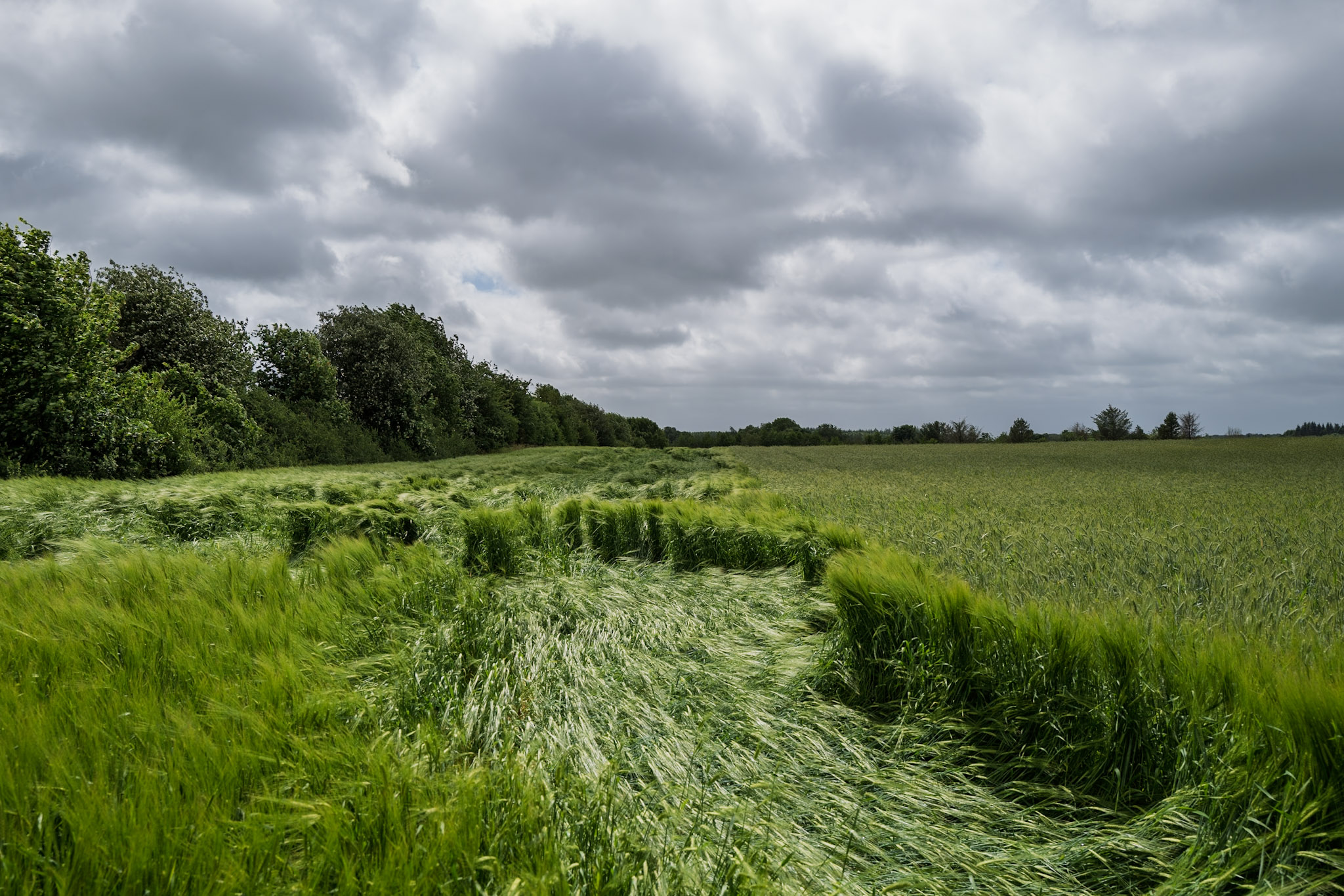
I ask how much difference the varieties make to the flavour of the whisky.
“I’m the farmer, so I feel they give the taste of my land.”
Then he qualifies it. He does not yet know whether this new one will taste different. That will need testing.
I like both parts of the answer. The first tells me why he cares. The second tells me how he intends to find out.
Jakob at Thy had been sceptical about the significance of individual soils compared with varieties. Lars’s connection to the land is more personal. These are not opposing sides in a debate I have arranged for them; they are people answering from different kinds of experience. Their agreement that grain matters does not oblige them to agree about everything it means.
At the distillery, Snævar Albertsson offers another way of understanding how something individual becomes part of a scene.
He is Icelandic, a musician who has toured in bands and knows the pleasure and fatigue of arriving somewhere with people expecting an evening from you. Our camper-van existence gives us a little common ground.
He describes writing music through long sessions of playing together, gradually finding the part worth developing into a song. Making whisky has supplied another creative partnership. There are experiments, preferences, things to discard and a style that becomes clearer through doing the work.
Sall began with seven people discussing the possibility. They invited the village to a meeting, expecting a handful of whisky enthusiasts. Half the town turned up. People offered to buy the first bottles before there was whisky to fill them. Wider crowdfunding followed, helping pay for the equipment.
The distillery stands where there had been a kitchen garden and chickens. Snævar’s home is so close that the bicycle is barely worth using. The separation between business, household and village is thin in a way that would be difficult to put convincingly into a brand presentation.
“Denmark is really a country of associations,” he says.
He sees the whisky community through that culture, and through music. Bands sharing a bill have an interest in getting an audience into the same room. Each can be distinct while benefiting from the strength of the scene.
Sall also benefited from people further along. An early visit to Stauning allowed the founders to ask questions, including, Snævar admits, some of the wrong ones. He has since given that kind of time to another group thinking about starting. Cooperation is something he can describe as an exchange of useful hours.
He pours the inaugural Sall release. It is three years old, matured in small former bourbon casks, with the barley and the intended weight of the spirit left clearly in view. I find it remarkably assured. There is grain, substance and a character I think I would recognise again. I do not need to describe it as promising to justify enjoying it now.
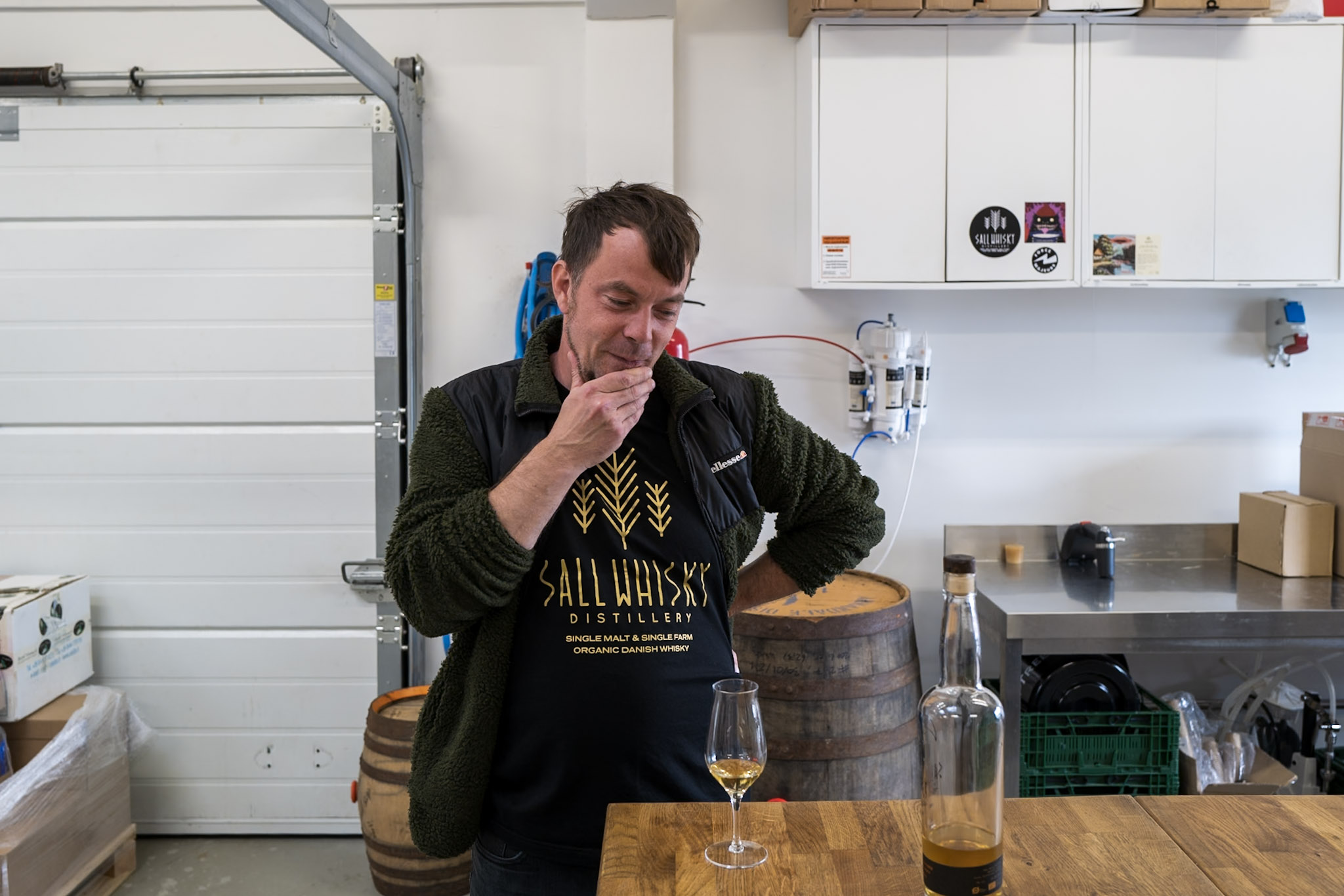
For Snævar, the importance of the release is inseparable from the people who had paid for it years before. Those advance purchases had kept the project going through weekends, holidays, building work and the effort of learning to make whisky while trying to construct a place in which to make it.
There had been a promise. Eventually, there had to be a bottle.
The attention extended to finding the bottling strength and hand-waxing the releases. Partway through the waxing, Snævar worked out how to make the finish look right and decided the earlier bottles needed doing again. It is a small, maddening detail. I find it more persuasive than being told that no effort was spared.
When the release finally came, the supporters were invited to celebrate, then to collect their bottles in smaller groups so the makers could shake hands and thank them. Six years of work and waiting could not sensibly be completed by sending a dispatch email.
The people who bought in early were being handed something worth the faith they had placed in it.
The oiliness of the new make, when we try it, is part of what he has been talking about. The grain, the small direct-fired stills and the preferences of the people making it have become something we can taste. I would want to drink this again away from the village, without anybody telling me its story.
Back at Nyborg
On Friday evening, Ulf and I are back outside Nyborg Destilleri.
We have spent more time with Nicolai. The journey has brought us to the place where the main journey began, which is convenient for a writer and slightly disorienting for the people inside it. To Nicolai, we have been away for a few days. To us, it feels much longer.
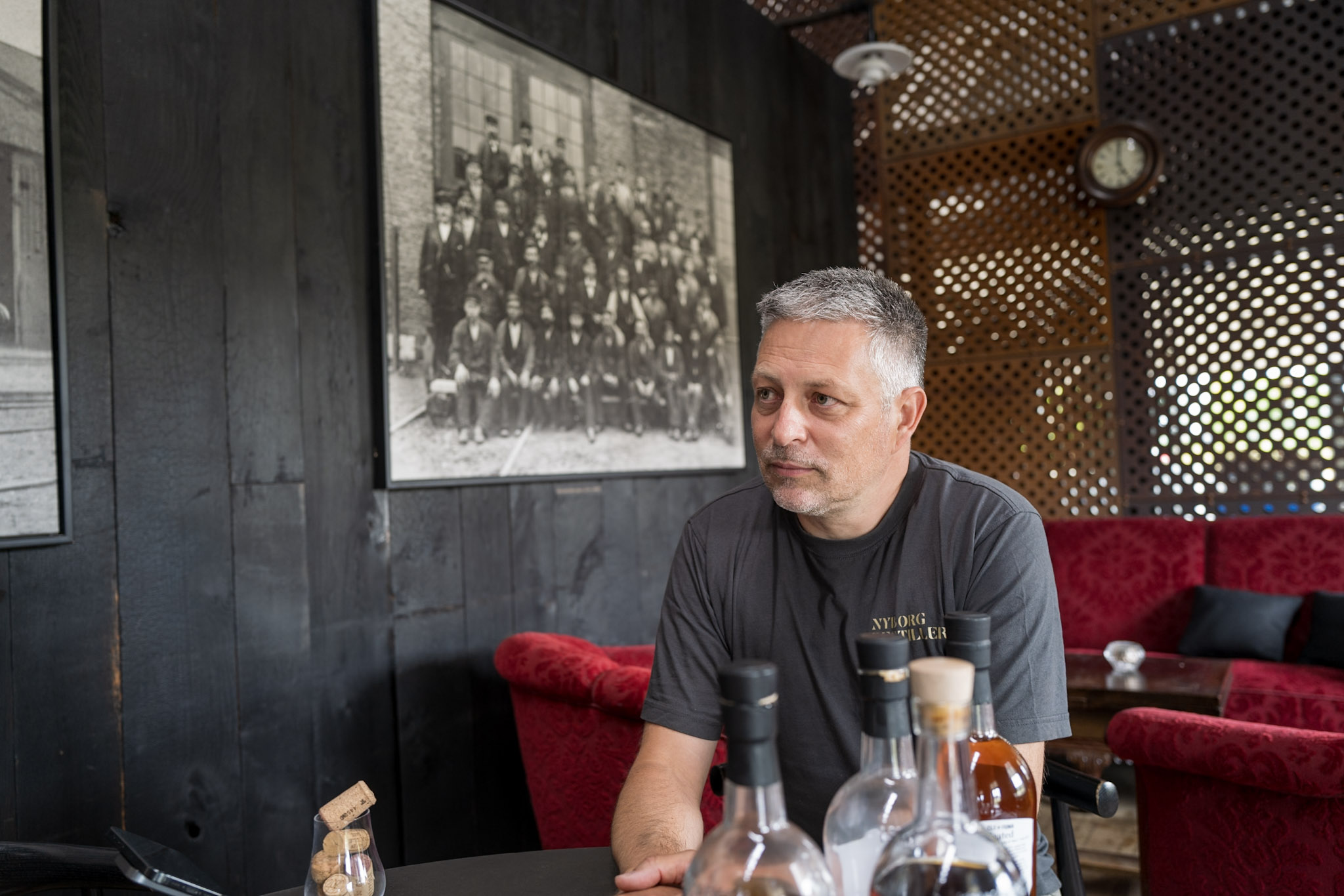
We switch on the recorder again.
At the beginning, Ulf had thought a young whisky country would probably need more years in cask before its whisky became fully convincing. Thornæs unsettled that assumption early. The visits kept doing it.
His verdict is succinct: “That is today so damn wrong.”
He is not claiming that every Danish whisky is excellent. Neither am I. We have tasted spirit that felt unfinished and casks that overpowered what was inside them. We have also tasted young whisky with enough texture, balance and individuality to make waiting for a more respectable age seem beside the point. Sall’s first release is three years old. More time may change it. It does not have to rescue it.
Nor has the trip supplied a flavour that can be called Danish and then applied to everything we have drunk. Copenhagen’s deliberate constructions, Fary Lochan’s nettle smoke, Thy’s grain work and Knaplund’s American inspiration would make a fairly unhelpful average.
What has become clearer is the work behind the word.
At first, the insistence on Danish grain had seemed almost too obvious to yield much of a story. By the end, I had seen the silos, the separate batches, the years of multiplying seed and the farmer considering how a crop stands up to weeds. I had also heard Karl explain the maize he could not reliably obtain here. A commitment becomes more credible when you can see both what sustains it and where it becomes difficult.
The manifesto has something worth protecting here. The common ground is substantial enough to make a promise to the person buying a bottle, while the differences give that person a reason to try the next one. A Danish whisky culture is already visible in the relationships between these producers, in the work they share and in the choices they make. It does not require everyone to converge on a flavour.
The harder conclusion is that deserving to exist will not keep a distillery open. Some of these businesses have other spirits or other income supporting the whisky. Some have families or communities prepared to wait. Stauning has a facility and stock built for a different level of activity. Nobody can turn good intentions, interesting grain or affectionate visitors directly into the money needed to fill the next cask.
That is not a reason to lower the ambition. It is a reason to pay attention to who bears its cost. The farmer growing less efficient grain. The family working weekends. The people whose jobs disappear when the forecasts change. A whisky country is made out of their decisions, too.
There is a risk in visiting young distilleries of treating the present as a prelude: everything promising, everything on the way, everybody waiting to become the thing that will eventually deserve our attention. Denmark has already made enough good whisky to be judged in the present. It has also reached the point where the survival of the work deserves as much scrutiny as its beginnings.
At Nyborg, the locomotive is still inside the warehouse. On our first evening it helped explain the size of the building. After the week we have had, I am more interested in the man trying to keep that building working.
Nicolai has described the worry, including nights when he wakes thinking about whisky. He has also described what he wants: casks being filled, bottles moving, people working. He likes to see a process running. That was what he wanted us to understand when he showed us the brewery, the tiles and the rooms he helped build.
“Make it alive. That’s my dream.”
By now, I hear more than Nyborg in those words. I think of René’s garage, of Jakob’s grain silos, of the family at Fary Lochan carrying on without Jens-Erik. The whiskies have led us back to the lives that made them possible.
Together, they have made a whisky country. Now it has to sustain the people who made it.
Reporting took place from 24 June to 3 July 2026, with further recorded reflections on 4 July. The Danish Whisky Manifesto covered the trip costs. I received no fee for the article. Photographs are by Ulf Lundquist.


Leave a Reply