
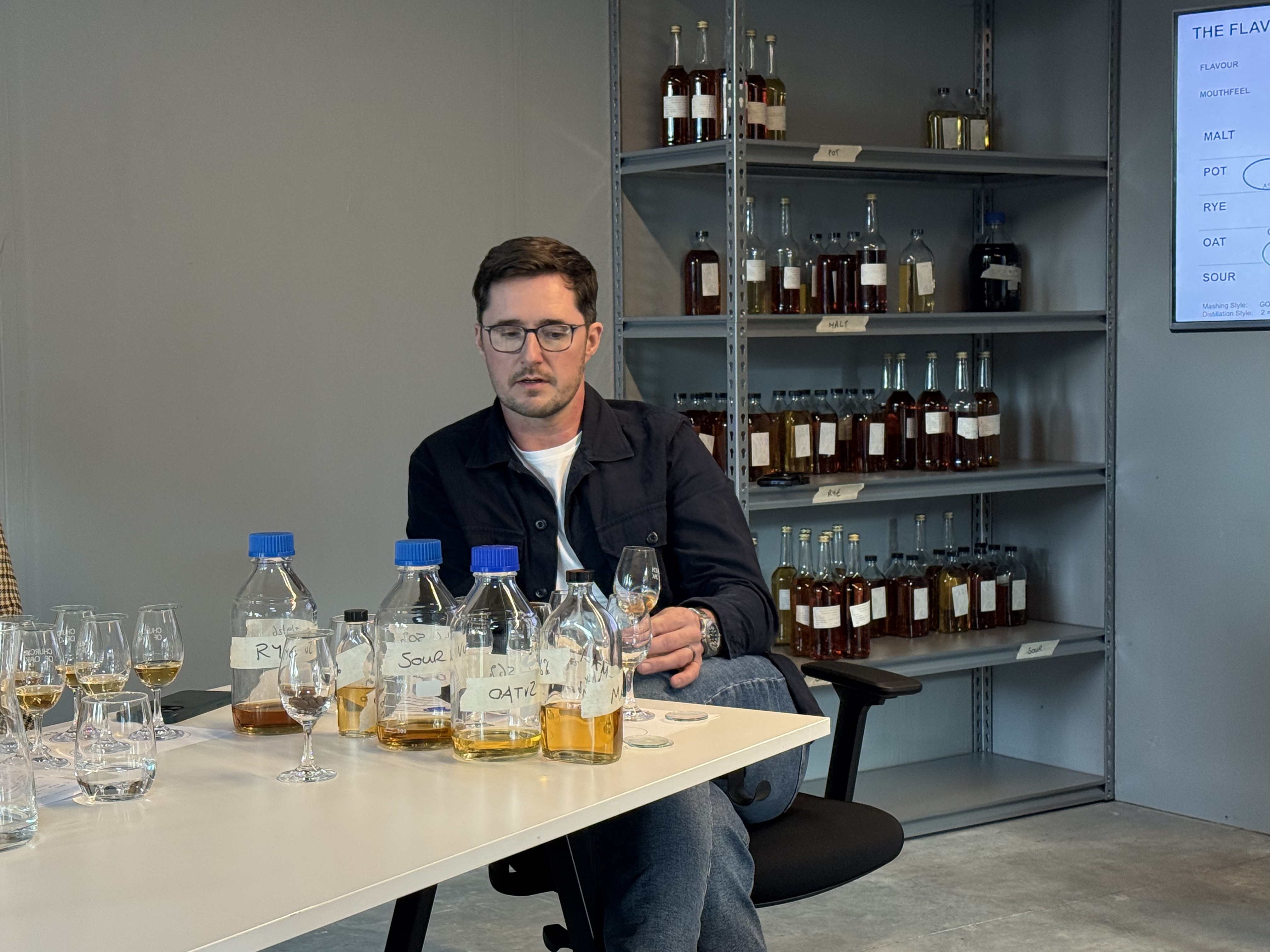
The bottles in front of Greg McEntee have blue plastic caps and handwritten labels stuck on with masking tape. Behind him, metal shelving holds more samples, organised into rows. It is the sort of arrangement you might find in a laboratory, or in the room visitors are normally hurried past on their way to somewhere more photogenic.
At Church of Oak, it is where I begin to feel most comfortable.
We have already walked through a distillery that has clearly cost an extraordinary amount of money. There has been concrete, copper, glass, engineering, architecture. There will be very good food. The building has given me occasional thoughts of a Bond villain’s headquarters, although nobody has yet appeared carrying a white cat.
Now there are five glasses, a distiller and some unfinished business.
Greg, Church of Oak’s head distiller, is careful about what we are tasting. These are examples of where the whiskey might go, assembled to show what the distillery can do. They are not a finished launch range. The eventual prices, combinations and route to the drinker are still being worked through.
That makes this an awkward thing to write about, and quite an interesting one.
I cannot tell you to buy a bottle. I cannot put its price beside something familiar and decide whether it makes sense. What I can do is describe the choices I saw, the people making them and the liquid those choices have produced so far. I can also admit that I came away excited, while remaining suspicious of how easy it is to become excited on a well-organised press trip.
Both things can be true. They were certainly true of me.
The maize that nearly wasn’t
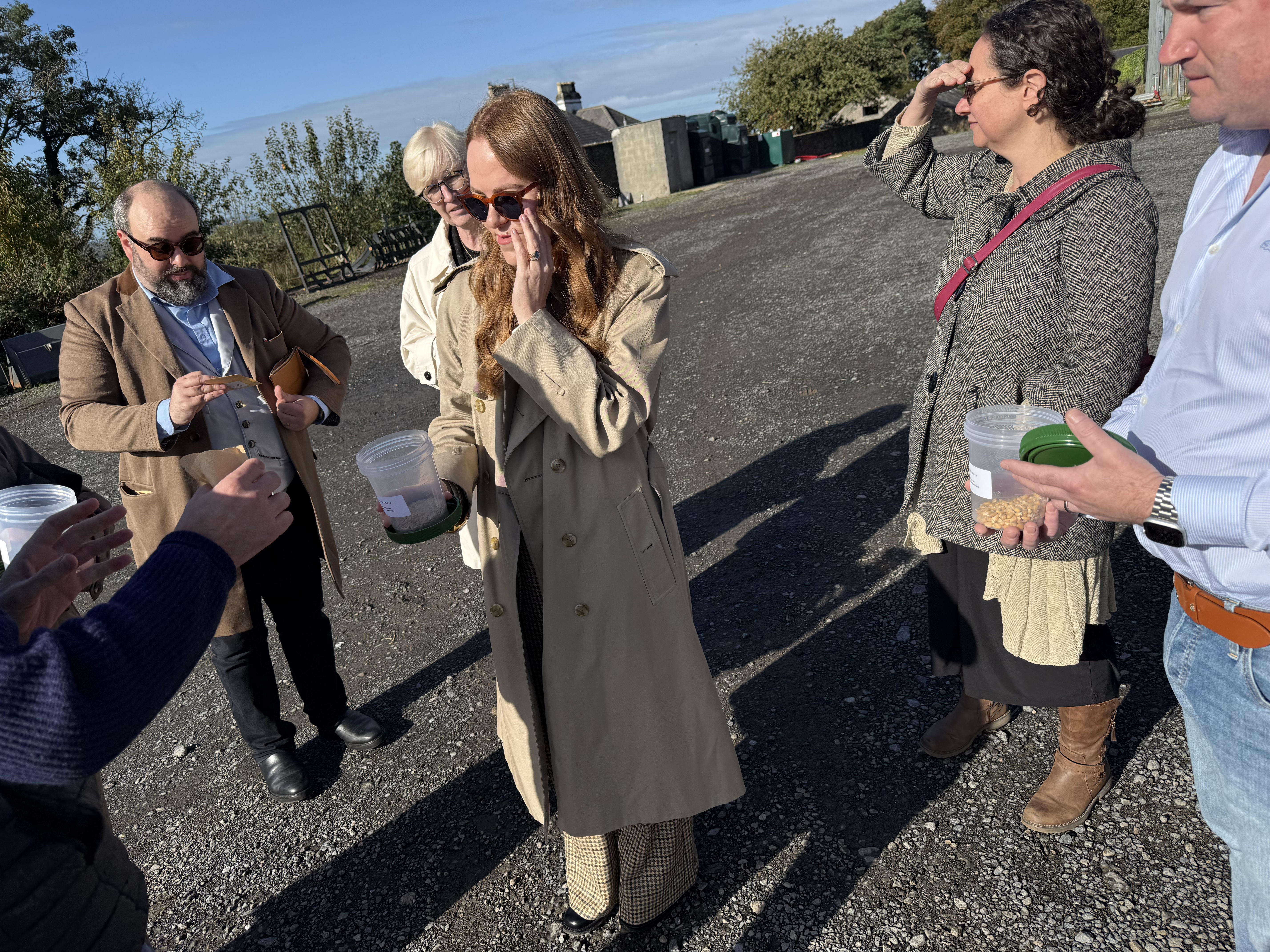
Earlier that day, at Garrett Headon’s farm, we had been passing around plastic tubs of grain.
Garrett is a farmer and maltster, quick to smile and quite willing to take a conversational diversion. His account of getting into malting contains the sort of detail that tends to disappear when a brand gets hold of it. Equipment that did not work. Equipment he could not afford. A customer waiting for something he had promised to deliver. The resulting need to build, adapt and get on with it.
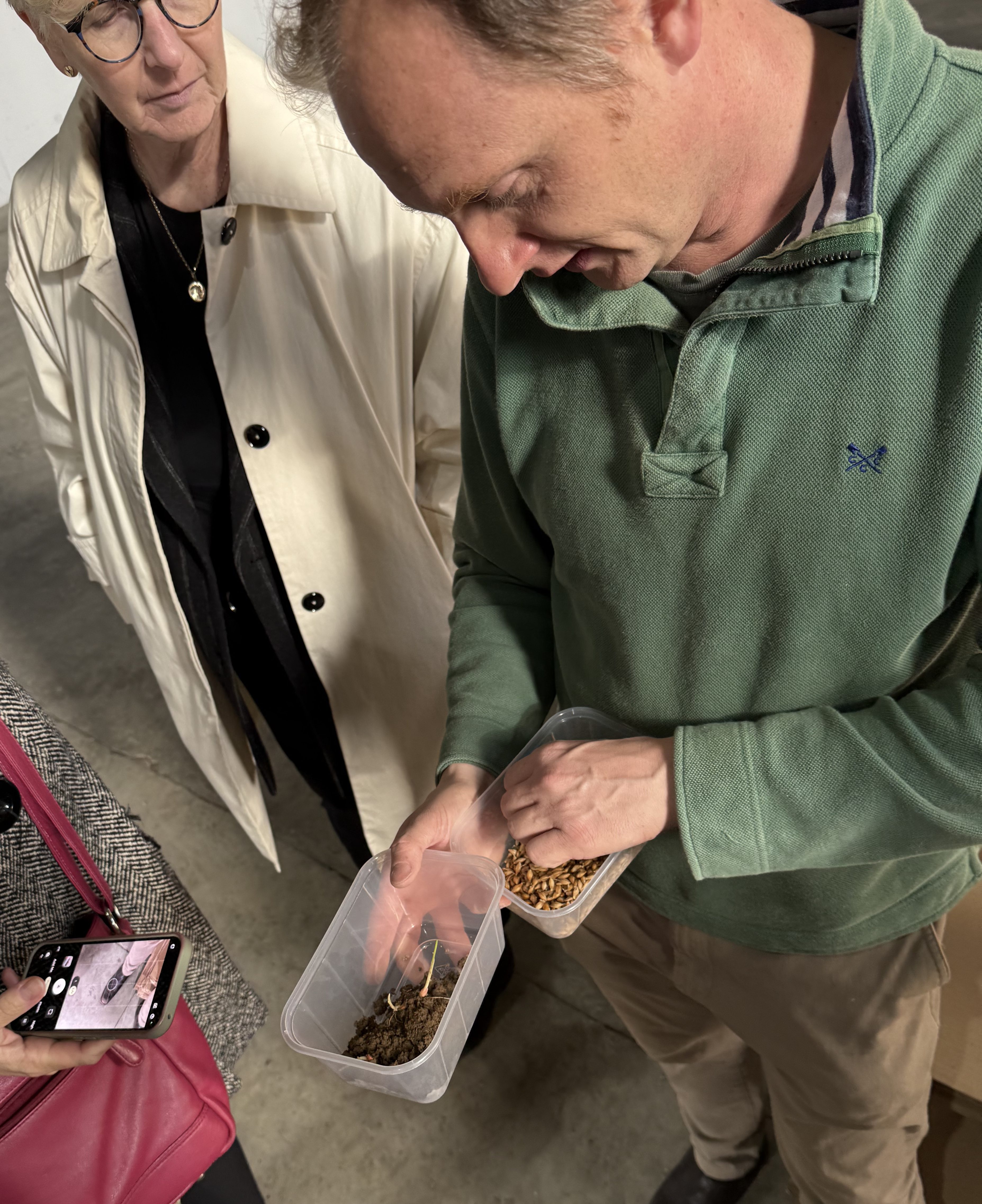
His operation has grown through those practical decisions. A newer steeping tank allows one batch to begin while another is still being processed. Further equipment will increase capacity and control. The consistent business from Church of Oak has helped give him the confidence to invest.
There is even a weighbridge that came out of the distillery site and found another working life here.
This is useful context for the word provenance. It can become rather weightless when repeated often enough. At Garrett’s, it involves machinery, storage, drying costs and the satisfaction of knowing what happens to a crop after it leaves the farm.
He described the familiar alternative: spend a year growing grain, deliver it to a mill, tip it out and say goodbye. Here, he can follow it through malting, distillation and maturation, eventually into a glass.
I asked whether he believed he could taste the land in the grain. His answer was pleasingly restrained. He did not know whether it was reflected in flavour. He did value knowing where it came from, and being able to follow that connection back to a field.
I trusted that answer more than I would have trusted a small sermon about terroir.
Then there was the maize.
When Church of Oak first asked Garrett about growing grain maize for them, his response was essentially that there was a reason people were not doing it. Ireland’s weather makes the proposition difficult. A good growing season does not guarantee a good harvest, and wet grain needs drying. Imported maize offers a much easier calculation.
They persisted. He tried.
Making it work involved decisions about seed rates, nitrogen and harvesting equipment. You need the crop to ripen and dry sufficiently, which is a different objective from producing the greatest possible bulk of lush material for animal feed. Garrett had learned where to compromise.
Could he compete on price with maize arriving from France? No.
Here, at least, was a clear answer to the question I kept returning to throughout the visit: what is the money doing?
In this instance, it was making a local agricultural choice commercially possible. That does not automatically make the resulting whiskey better. It does give the choice substance.
What the money makes possible
There is money at Church of Oak. Unashamed amounts of it, judging by the building.
I find neither automatic admiration nor automatic contempt particularly useful responses. Whisky has never been entirely short of wealthy people wishing to make something that will outlast them. The more interesting question is what their resources allow other people to do.
Arriving at the distillery, you follow a descending path between rust-coloured walls and planting, with the grain silos rising above you. From inside, a circular glazed opening frames a silo against the sky. Elsewhere, a window at the end of a concrete passage gives a carefully composed view of working equipment. A glass floor lets you look down into the machinery beneath your shoes.
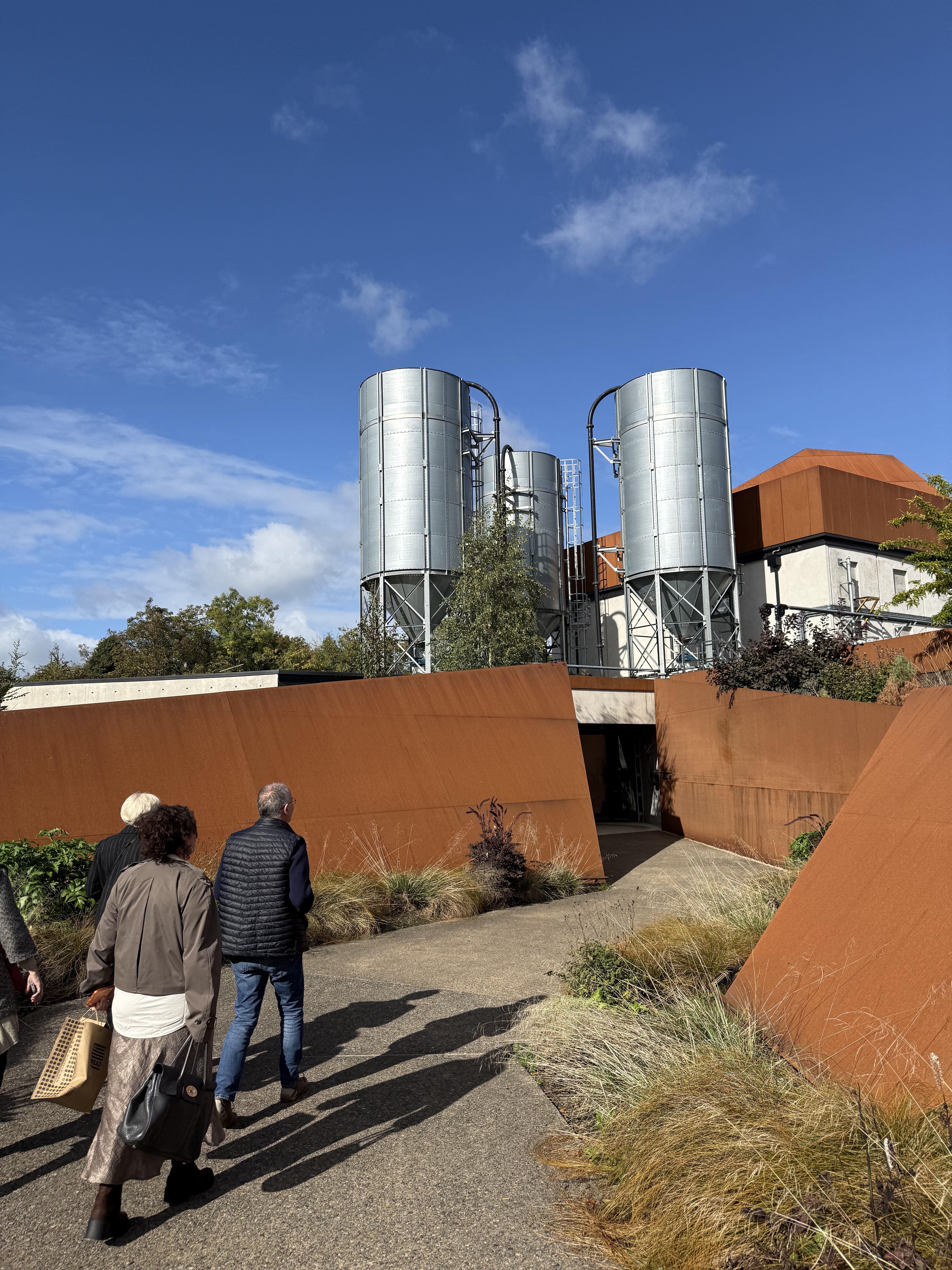
Greg points out the intention: the grain comes first, and the process should be visible.
Of course, transparency is a favourite corporate word. Making a window does not, by itself, establish honesty. But this is an unusually literal effort to let visitors see what a distillery does.
I had been slightly apprehensive about the promised brutalism. In person, the descent, planting and relationship between the old site and the new work made more sense than I had expected. The building felt connected to its setting, even when its interiors suggested that someone might shortly announce the activation of a reactor.
It also needed people.
Grainne Maguire, who leads the visitor experience, brought a measured poise to the visit, in a cream coat and patterned glasses. In her account of the site’s past and its possible future, the surrounding community remained part of the conversation. There were plans for access between the canal towpath and the local GAA grounds, and for bringing people into the spaces being created. Those are intentions worth returning to when the visitor experience opens.
Ger Garland, Church of Oak’s international commercial manager and someone I have known for years, supplied a different kind of reassurance. He has a way of attending to the small practical details of hospitality without making a production of it. In a building capable of feeling rather formidable, that warmth mattered.
The architecture could establish the scale of the ambition. It took the people to make me want to stay.
So many ways to make a whiskey
Greg is calm, methodical and very good at explaining why something that sounds straightforward is not.
His production experience includes Girvan and the grain distillery project at Tullamore. At Church of Oak, he has the tools to make an unusually wide range of spirit, and the responsibility of making that range repeatable.
Four large grain silos are one early clue. During a single-malt production run, most may stand empty. A distillery concentrating on one recipe could regard that as an expensive waste of space. If you want to make whiskey from several grains, however, you need somewhere to keep them separately.
Further into the building, there are different milling and mashing options. There are ways to process liquid with the grain solids removed, and ways to keep them through fermentation and distillation. The still arrangement permits double, triple and two-and-a-half distillation.
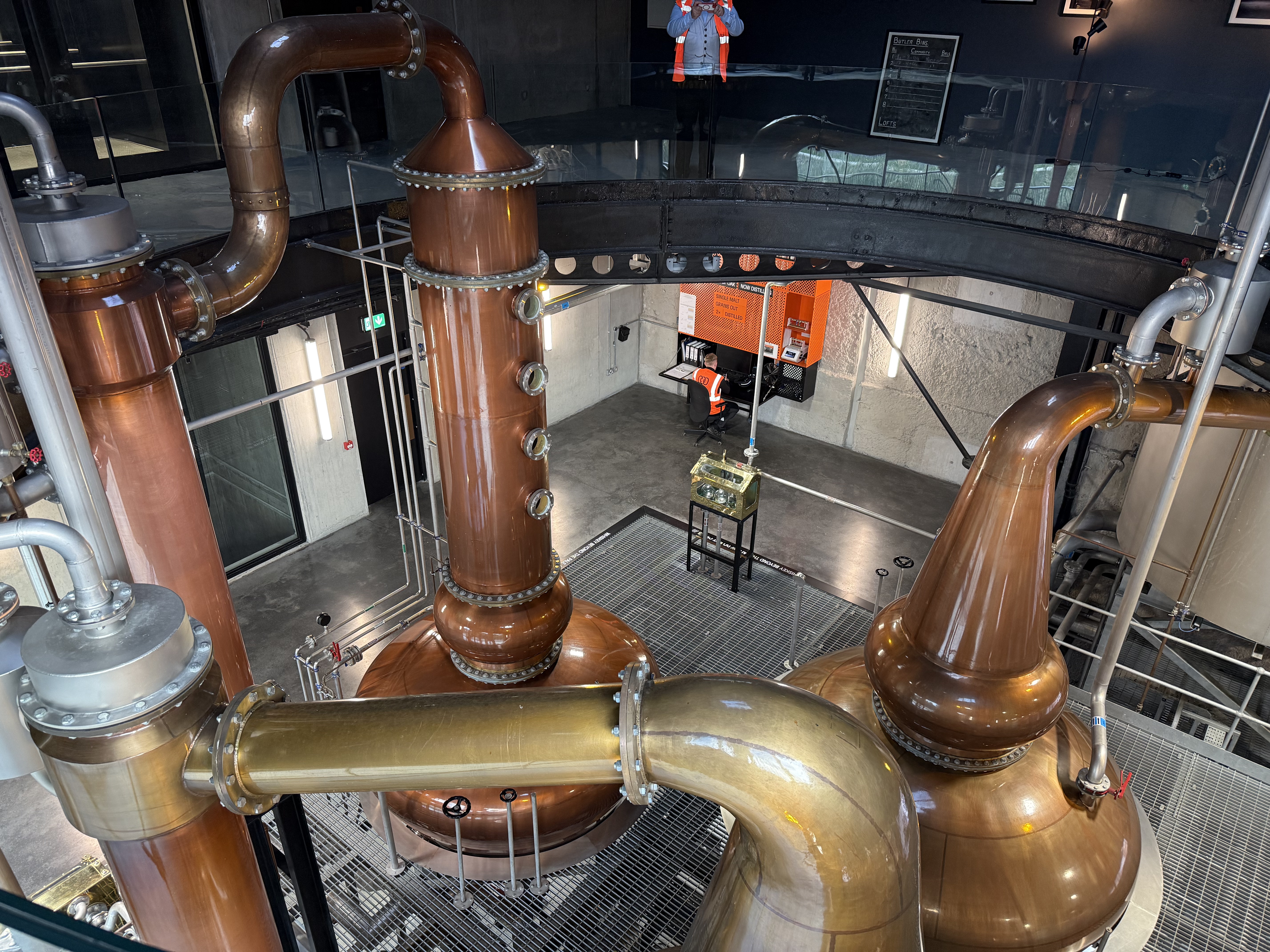
The technical detail is fascinating, and I could happily disappear into it. What matters here is that the variety begins well before a cask is selected.
Barley, rye, oats and maize offer different starting points. How they are processed changes what survives into the spirit. The distillery can then combine those differences, rather than relying on wood to provide all the variation later.
Greg described fourteen new-make styles already in production. A slide in the tasting room plotted the wider palette across flavour and mouthfeel: fruity, floral, spicy, herbal, savoury, rich and bready.
There is a danger, looking at such a diagram, of mistaking the number of possibilities for an achievement in itself. An enormous menu is not proof of a good restaurant.
What reassured me was Greg’s willingness to explain the limits. Oats are difficult and inefficient. Some styles are made in small enough quantities that spreading them across further variations would make little sense. There are more experiments he could pursue, but keeping certain things consistent is also a choice.
The freedom is considerable. So is the need for discipline.
Later, when I asked about following him on Instagram, he warned me that I would not find much whiskey content there. His other life involves skydiving.
Initially, that seemed an entertaining contradiction to the composed man explaining production decisions. The more I thought about it, the less contradictory it seemed. Preparation, repetition and understanding the consequences of a decision would appear fairly useful in both occupations.
Try putting all that on a label
At the farm, Racheal Vaughan Jones had been among us with one of those plastic grain tubs. Later, across the tasting table, she was explaining the challenge of turning this abundance of possibilities into something people could understand.
In between, she had found time to describe a tractor as sexy. I appreciated the range.
As global marketing and innovation director, her job involves an uncomfortable act of compression. All the detail that excites someone like me must eventually become a bottle, a few words, a conversation at a bar. Most customers will not have stood beside Garrett’s equipment or followed Greg around the stills. They will encounter Church of Oak among other things they already recognise.
Church of Oak’s CEO, Enda O’Sullivan, seemed comfortable with that discussion. He has the physical assurance of someone you could imagine having played rugby, although I have no idea whether he ever did. An experienced spirits executive, he was ready to engage with questions about the business as well as its aspirations.
I asked what sort of world the founders had imagined their whiskey entering. The answer emphasised patience: this had always been intended as a long-term project. There had been no desire to create a gin to bridge the wait, or to buy whiskey elsewhere and establish the name through that.
That is a privileged position, and a useful one. It allows decisions that would be impossible for a business needing its next release to pay for the one after it.
It does not make the eventual customer irrelevant. I pressed on that, too.
The moment the liquid had to speak
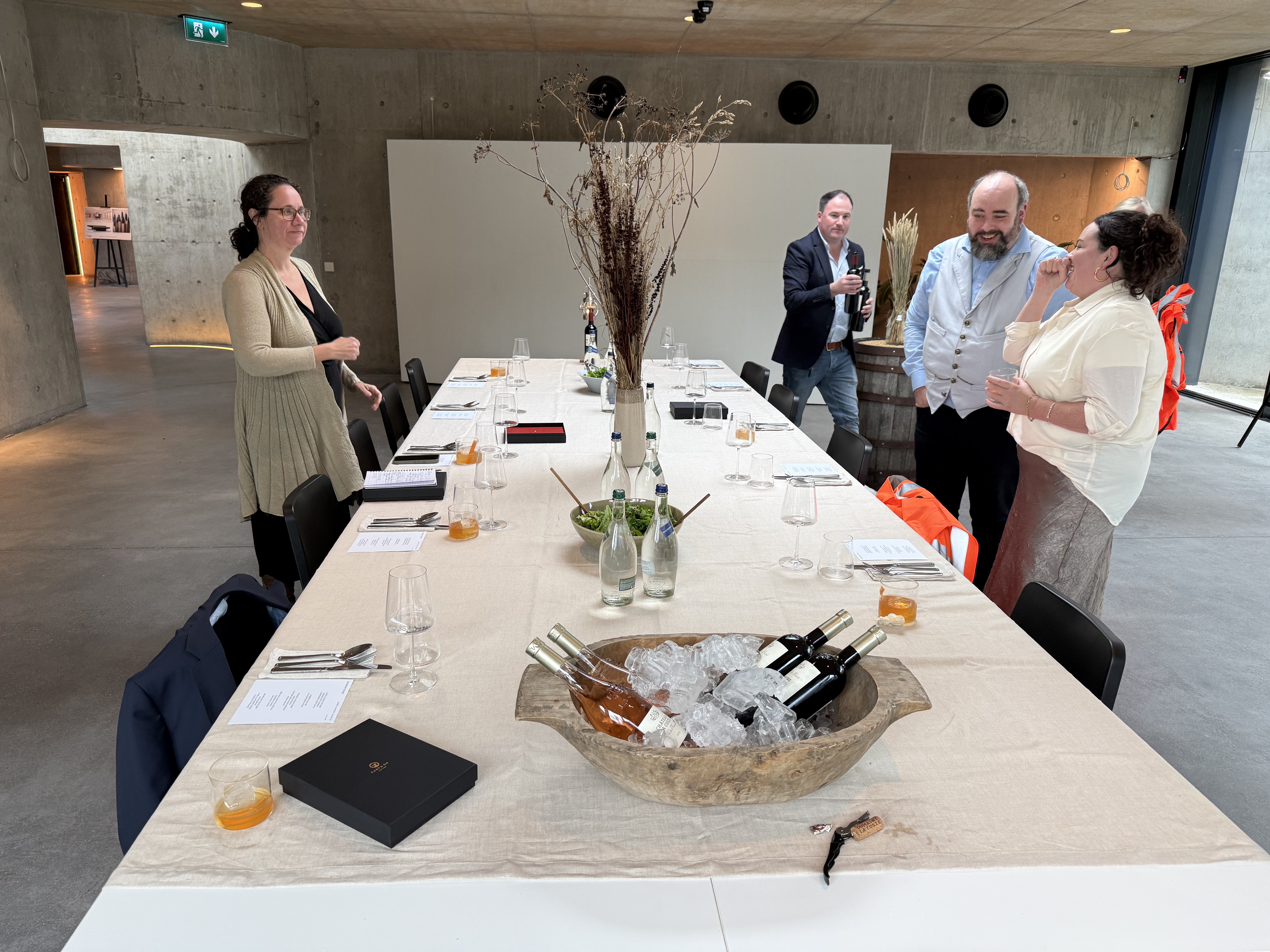
The tasting gave the discussion something solid to stand on.

The single malt was the easiest initial point of connection: cereal, generous fruit, a lovely suggestion of barbecued pineapple and banana, with sufficient dryness to keep the whole thing in balance. It felt beautifully made. I could understand it quickly, without feeling I had exhausted it.
The oat spirit was more difficult for me. There was an oily, grassy quality, a savoury edge and a menthol character that lingered. It was intriguing, sometimes a little closed, and I was less sure where I wanted it to go.
That uncertainty is part of the interest in seeing work at this stage. Something can be well made without immediately being the thing you most want to drink. It might also contribute something valuable in combination that would be harder to appreciate alone.
The sour mash, drawing on an American approach and using maize, was deeply promising. I wanted a little more time for it to come together, but the direction was compelling and the finish kept going.
Then the pot still caught my attention.
It had the recognisable vocabulary of the style, including spice and a substantial mouthfeel, but the herbal and savoury elements took it somewhere of its own. I told Greg that it felt like this distillery’s interpretation of pot still whiskey. It had not simply located a successful reference point and set about getting close to it.
That distinction matters to me. Irish whiskey has room for more than variations on the things we already admire.
The rye was the other standout. Double distilled with the grains retained, then matured in fortified-wine casks, it was recognisably rye without seeming obliged to behave like an American example. I found it refined, approachable and absorbing. Rye is not always the style that most excites me. This could change that.
Returning to the glasses, I found myself smelling them after they were empty. The pot still in particular left something I did not want to put down.
So there is a judgement I am willing to make now: the liquid justified serious attention. My enthusiasm did not depend entirely on the building.
Whether it justified an eventual asking price was a question none of us could yet answer.
And then there’s the price
I brought up Waterford during the conversation.
There are obvious differences between the projects, but a customer does not necessarily begin with those differences. A young whiskey arrives with an elaborate explanation of provenance and production, and a price that places it beside established names. How much of that explanation reaches the person deciding what to order?
It is possible to admire a distillery’s choices and still leave its bottle on the shelf.
Enda returned to the quality of the liquid, and to the emotional as well as rational reasons people choose one drink over another. Racheal spoke about thinking beyond the familiar whisky category playbook.
I understood the ambition. I also wanted to know how it would work in the small, ordinary moment when someone has to spend their own money.
A bartender may have thirty seconds. A label has less. The drinker cannot be expected to reconstruct our day in Kildare before making a decision.
When I pressed on price, Racheal suggested I would be pleasantly surprised. I hope so. That is a recollection to take forward, rather than a price commitment to hang around her neck.
I do not expect well-made things to be cheap. Garrett’s maize costs what it costs. Equipment, people, maturation and the acceptance of lower yields all have consequences.
My nervousness begins with the word luxury, and the room it creates between what something costs to make and what someone might be persuaded to pay for it.
Drinking whiskey can be a luxurious experience. I have had it in modest bars, at kitchen tables and with bottles that required no financial planning. Turning that experience into a luxury product can change who feels welcome to take part.
Church of Oak speaks about community. There is the local community, which may benefit through work, access and activity. There is also the community it hopes to build around the whiskey, including people far beyond Ireland.
Those ambitions deserve to be taken seriously. They also deserve to be tested against what eventually becomes available, where, and at what price.
For the people who weren’t in the room
It would be convenient to finish with a verdict.
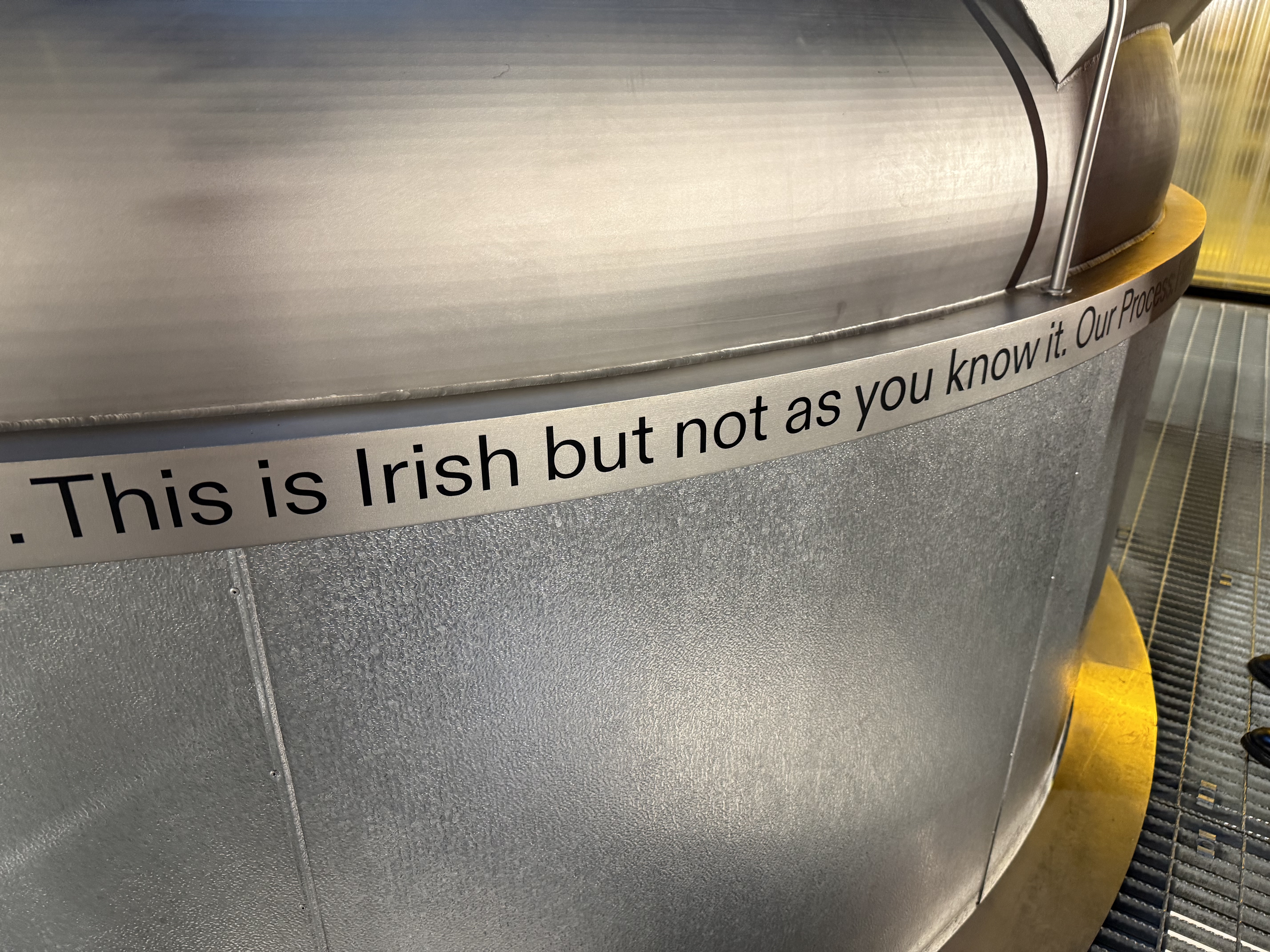
Instead, I keep thinking about how specifically Irish this project felt, despite how little it resembled an expected version of an Irish distillery. The grain, the practical ingenuity at Garrett’s farm, the people and the relationship with the surrounding place gave it substance. The willingness to make something unfamiliar gave it possibility.
None of that required a claim that everything had been better in the past.
I also keep thinking about my own position. I had been invited in, given time with people whose work interested me, fed very well and offered some excellent spirit. Asking awkward questions was part of doing my job. It was not a vaccination against enjoying the treatment.
Back home, the samples have to be considered alongside the unanswered questions. The pleasure survives that exercise. So does the uncertainty.
The team has spoken of its different spirits as threads. There is enough here, I think, to weave something distinctive. The harder task will be making the result mean something to a person who never heard Garrett explain the maize, never looked down through the glass floor and never sat across from Greg’s masking-tape bottles.
Church of Oak has spent a great deal of money giving its makers freedom.
How much of that freedom will reach the drinker?
I visited Church of Oak as a guest on a hosted press trip. The spirits described were developmental samples, rather than a confirmed retail range.


Leave a Reply